2015 AMC 10B Problem 8
The letter F shown below is rotated clockwise around the origin, then reflected in the -axis, and then rotated a half turn around the origin. What is the final image?
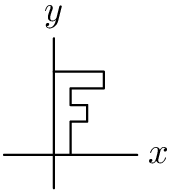

Show solution without answering
Key insight
Follow one point through all three moves: (x, y) ends up at (y, x). So the three moves together just flip the F across the line y = x.
Solution
Instead of redrawing the F three times, follow what each move does to the coordinates of a point.
- Turn clockwise about the origin. Try the point on the positive -axis: a quarter turn clockwise sends it down to . Try on the positive -axis: it goes to . In general, goes to .
- Reflect in the -axis. This changes the sign of the first coordinate: goes to .
- Half turn about the origin. This changes the sign of both coordinates: goes to .
So after all three moves, every point ends up at . The two coordinates just swap. That is a reflection across the line .
Now use two corners of the F to find the picture.
- The F's upright stem sits on the -axis, with its bottom right corner at about . Swapping gives : a point on the -axis.
- The top left corner of the F is at the top of the -axis, about . Swapping gives : a point far out on the -axis.
So the stem now lies flat along the -axis, running out to about , with its left end against the -axis, and the arms of the F now point up. That is picture (E).
The answer is .
Why this works
A chain of moves is easier to handle as a coordinate rule than as a picture: write each move as a rule and apply them in order. There is also a quick check. The chain has one reflection, and one reflection always turns a shape into its mirror image, so pictures (A), (C) and (D), which are just the F turned around, cannot be right.
Concise solution
A shorter write-up, the way contest solutions are usually written. It may take a different route from the solution above.
Follow a general point through the three moves.
- Rotation clockwise about the origin: .
- Reflection in the -axis: .
- Half turn about the origin: .
The net map is : a reflection across the line .
Now apply it to the F. Its stem runs up from the -axis along , with the two arms pointing right and the long top bar at . Swapping coordinates turns the stem into a segment along starting at the -axis, the arms now point up, and the long bar becomes vertical at . That is an F lying on its back in the first quadrant, which is picture (E).
The answer is .
Review in the AoPS books
- Introduction to Geometry, Chapter 16: The More Things Change. . . (§16.1, §16.2, §16.3, §16.4)
- Introduction to Geometry, Chapter 17: Analytic Geometry
- Introduction to Algebra, Chapter 8: Graphing Lines
Similar problems
Problem © Mathematical Association of America (MAA), American Mathematics Competitions. Reproduced for non-commercial educational use. Solution and commentary are original to this site.