2006 AMC 10A Problem 12
Rolly wishes to secure his dog with an 8-foot rope to a square shed that is 16 feet on each side. His preliminary drawings are shown.
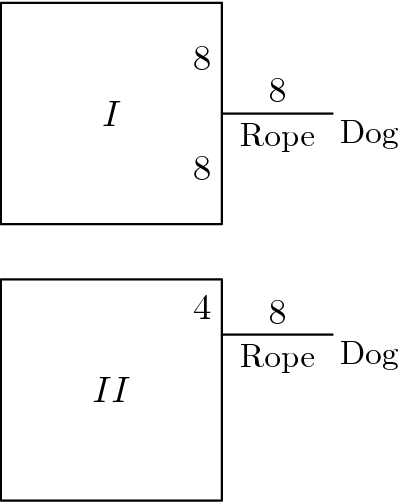
Which of these arrangements give the dog the greater area to roam, and by how many square feet?
Show solution without answering
Key insight
Both drawings give the same half-circle of radius 8. In II the rope reaches past the nearby corner with 4 feet left over, adding a quarter-circle of radius 4.
Solution
Picture where the dog can walk. Along a wall the rope swings in a half-circle; when the rope reaches a corner with some length left, it bends around the corner and swings a smaller piece.
1. Arrangement I. The rope is tied at the middle of a -foot side, feet from each corner. The rope is feet, so the dog sweeps a half-circle of radius outside that wall:
The rope just reaches each corner with nothing left over, so there is nothing more.
2. Arrangement II. The rope is tied feet from one corner (and feet from the other). The dog still gets a half-circle of radius along the wall: .
3. Now the near corner is only feet away, so the rope reaches it with feet left. Bending around the corner, the dog sweeps a quarter-circle of radius along the next wall:
The far corner is feet away, more than the rope, so nothing extra there.
4. Compare. II gives , and I gives . II is bigger by .
The answer is .
Why this works
A tied animal's region is made of pieces of circles: a big piece where the rope swings freely, and a smaller piece at each corner the rope can wrap around, whose radius is the rope that is left over. When comparing two setups, only the pieces that differ need to be computed.
Concise solution
A shorter write-up, the way contest solutions are usually written. It may take a different route from the solution above.
In arrangement I the rope is tied to the midpoint of a -foot side, feet from each corner. The dog can sweep a half-disk of radius on the outside of that wall:
The rope exactly reaches each corner with nothing left over, so no further region is added.
In arrangement II the tie point is feet from one corner and feet from the other. The same half-disk of radius is available (the wall blocks the other half exactly as before), giving . But now the rope reaches the near corner with feet to spare, and bending around that corner it sweeps a quarter-disk of radius along the adjacent wall:
On the far side, , so the rope never reaches that corner.
Arrangement II gives , exceeding arrangement I by .
The answer is .
Review in the AoPS books
- Introduction to Geometry, Chapter 11: Circles
- Introduction to Geometry, Chapter 4: Perimeter and Area (§4.2, §4.3)
- Introduction to Geometry, Chapter 12: Circles and Angles
- Introduction to Geometry, Chapter 13: Power of a Point
Similar problems
Problem © Mathematical Association of America (MAA), American Mathematics Competitions. Reproduced for non-commercial educational use. Solution and commentary are original to this site.