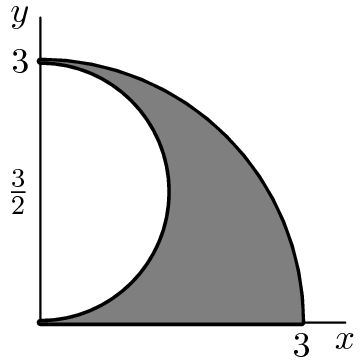
The shaded region below is called a shark's fin falcata, a figure studied by Leonardo da Vinci. It is bounded by the portion of the circle of radius and center that lies in the first quadrant, the portion of the circle with radius and center that lies in the first quadrant, and the line segment from to . What is the area of the shark's fin falcata?
- A)
- B)
- C)
- D)
- E)
Answer
B
Key insight
The falcata is a quarter disk of radius 3 with a half disk of radius 3/2 removed: 9pi/4 - 9pi/8 = 9pi/8.
Solution
The large circle, centered at the origin with radius , contributes the quarter disk in the first quadrant:
The small circle has center and radius , so it passes through and and its center sits on the -axis. Exactly half of it lies in the first quadrant (the right half), and that half disk is cut out of the quarter disk:
Falcata area:
The answer is .
Why this works
Curved regions bounded by circular arcs are almost always "big sector minus small sector or disk." Identify each arc's circle, decide what fraction of that circle the arc encloses (using where the center sits relative to the axes), and subtract. Here the small circle is tangent to the -axis at the origin and bisected by the -axis, so the piece removed is precisely a semicircle.
The trap
Subtracting a quarter of the small circle instead of half of it; the small circle is centered on the y-axis, so exactly half of it lies in the first quadrant.
Common mistakes
- Subtracting a quarter of the small circle instead of half of it; the small circle is centered on the -axis, so exactly half of it lies in the first quadrant.
- Using diameter (radius ) for the small circle, or subtracting the whole small disk.
Techniques
Cut the figure into known shapes (triangles, rectangles, sectors)