2014 AMC 10B Problem 23
A sphere is inscribed in a truncated right circular cone as shown. The volume of the truncated cone is twice that of the sphere. What is the ratio of the radius of the bottom base of the truncated cone to the radius of the top base of the truncated cone?
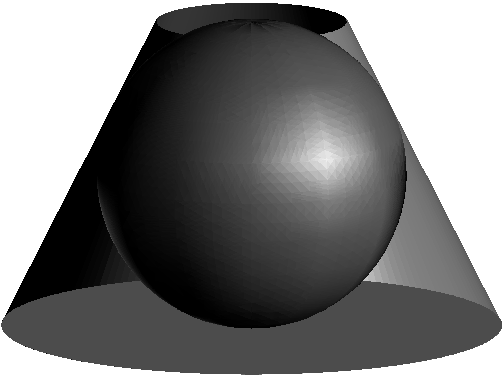
Show solution without answering
Key insight
Slice through the middle: a circle inside a trapezoid. Equal touching segments make the slanted side R + r, so sphere radius squared equals Rr.
Solution
Call the bottom radius , the top radius , and the sphere's radius . We want .
Step 1: turn it into a flat picture. Slice the solid straight down through its middle. The cut-off cone becomes a trapezoid with parallel sides (bottom) and (top), and the sphere becomes a circle of radius touching all four sides. The circle touches the top and the bottom, so the height is .
Step 2: find the slanted side. From any point outside a circle, the two touching segments to the circle have equal length. Use this at the two ends of a slanted side:
- From the top corner, the segment to the top touching point (the middle of the top side) is , so the segment along the slanted side is also .
- From the bottom corner, the segment to the bottom touching point is , so the segment along the slanted side is also .
So the slanted side is .
Step 3: link to and . Drop a height from a top corner to the bottom. It makes a right triangle with a horizontal leg of , a vertical leg of , and the slanted side as hypotenuse:
Expanding, , so and
Step 4: use the volumes. The volume of a cone with its top cut off (height , radii and ) is . With this is . The sphere's volume is . The solid is twice the sphere:
Divide both sides by : . So
Step 5: solve for the ratio. Divide by and write : . The quadratic formula gives
The bottom is the larger base, so , and .
The answer is .
Why this works
A ball inside a round solid with the same axis is really a flat problem: slice through the middle and you get a circle inside a trapezoid. The fact that the two touching segments from a point to a circle are equal gives the slanted side for free, and one Pythagorean step turns "the ball fits snugly" into . Since the question only asks for a ratio, dividing by leaves one equation in one unknown.
Concise solution
A shorter write-up, the way contest solutions are usually written. It may take a different route from the solution above.
Let the bottom and top radii be and , and the sphere's radius . Slice through the axis: the frustum becomes an isosceles trapezoid with bases and , and the sphere becomes its incircle, so the height is .
A quadrilateral with an incircle has equal sums of opposite sides, so where is the slant side: . Dropping a perpendicular from the top base gives a right triangle with legs and and hypotenuse :
Now the volumes. Frustum: . Sphere: . The condition "frustum is twice the sphere" gives
so . Divide by and set :
Since the bottom base is larger, , so .
The answer is .
Review in the AoPS books
- Introduction to Geometry, Chapter 14: Three-Dimensional Geometry
- Introduction to Algebra, Chapter 10: Quadratic Equations – Part 1 (§10.2, §10.3, §10.4)
- Introduction to Geometry, Chapter 11: Circles
- Introduction to Geometry, Chapter 19: Problem Solving Strategies in Geometry (§19.1)
Similar problems
Problem © Mathematical Association of America (MAA), American Mathematics Competitions. Reproduced for non-commercial educational use. Solution and commentary are original to this site.