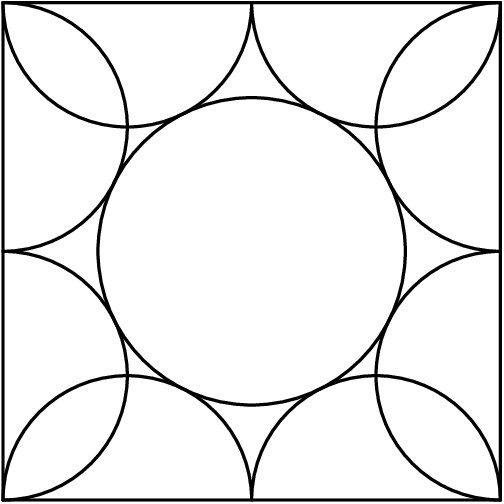
Eight semicircles line the inside of a square with side length 2 as shown. What is the radius of the circle tangent to all of these semicircles?
- A)
- B)
- C)
- D)
- E)
Answer
B
Key insight
The tangent circle is centered at the square's center; its radius plus 1/2 equals the distance to a semicircle center, which is sqrt(5)/2.
Solution
Put the square's center at the origin, so its vertices are . Each side of length carries two semicircles, so each semicircle has diameter and radius , with its center at the midpoint of a half-side. On the top side the two centers are ; the other six are the rotations of these.
By the square's symmetry the circle tangent to all eight semicircles is centered at the origin. Its radius is determined by tangency to any one semicircle, say the one centered at . The distance from the origin to that center is
The small circle and the semicircle are externally tangent, and the tangency point lies on the semicircle's arc (the segment from the semicircle's center toward the origin points into the square). So the distance between centers equals the sum of the radii:
The answer is .
Why this works
Tangency between circles is a statement about centers: distance equals sum (external) or difference (internal) of radii. Symmetry places the unknown center, coordinates give the distance, and one equation finishes. Whenever a figure has a symmetric family of circles, connect the centers before anything else.
The trap
Taking the semicircles to have radius 1 (diameter equal to the side) instead of radius 1/2, since two semicircles share each side.
Common mistakes
- Taking the semicircles to have radius 1 (diameter equal to the side) instead of radius 1/2, since two semicircles share each side.
- Measuring from the origin to the top of the semicircle along the vertical line through its center () instead of along the line joining the two centers.
Techniques
Place the figure on coordinates and compute · Exploit symmetry to reduce work or pair up objects