2012 AMC 10A Problem 15
Three unit squares and two line segments connecting two pairs of vertices are shown. What is the area of ?
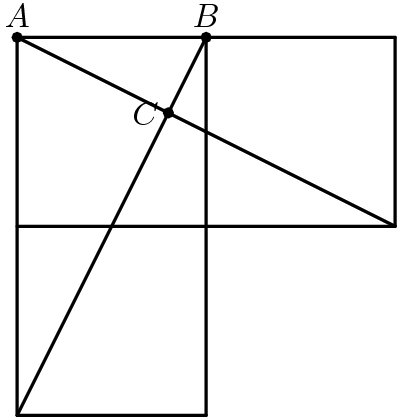
Show solution without answering
Key insight
AB has length 1, so only the height of C below AB matters. One segment drops 1 per 2 across, the other 2 per 1 across; they meet 2/5 down.
Solution
Side is the top edge of one unit square, so it has length . The area is , where the height is how far is below line . So we only need that height.
1. Put the grid on coordinates. Let and . The two top squares fill and , and the third square sits under the left one, filling and .
2. The first segment goes from to the right-hand corner . It drops while moving to the right, so at any point on it, the drop is half the distance across. Its equation is .
3. The second segment goes from down to the bottom-left corner . It drops while moving to the left, so its slope is . It passes through , so its equation is .
4. is where the two lines meet, so set the two -values equal:
Then .
5. So is below line , and the area is
The answer is .
Why this works
A picture made of unit squares is already a coordinate grid, so every corner has whole-number coordinates and every segment between corners has an easy equation. Where two lines cross, set their equations equal. With a flat base of known length, the area only needs the vertical distance of the third corner.
Alternative approach
Skip the equations. Say is below and to the right of . Along segment the drop is half the distance across, so . Along segment , the point is to the left of , and the drop is twice that, so . Setting them equal, , gives and . The area is .
Concise solution
A shorter write-up, the way contest solutions are usually written. It may take a different route from the solution above.
Place and , with the squares below the -axis: two side by side occupying , , and one more below the left square occupying , .
One segment runs from to the far corner ; its line is . The other runs from to the bottom corner ; its line has slope , so it is .
Point is where they meet:
Triangle has base and height equal to the distance from to line , which is . Its area is
The answer is .
Review in the AoPS books
- Introduction to Geometry, Chapter 4: Perimeter and Area (§4.2)
- Introduction to Geometry, Chapter 3: Congruent Triangles
- Introduction to Geometry, Chapter 17: Analytic Geometry (§17.4, §17.6)
- Introduction to Geometry, Chapter 6: Right Triangles (§6.1, §6.2, §6.3)
Similar problems
Problem © Mathematical Association of America (MAA), American Mathematics Competitions. Reproduced for non-commercial educational use. Solution and commentary are original to this site.