2014 AMC 10B Problem 15
In rectangle , and points and lie on so that and trisect as shown. What is the ratio of the area of to the area of rectangle ?
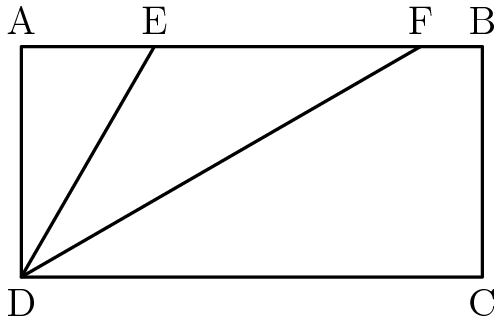
Show solution without answering
Key insight
Splitting the right angle at D into three equal parts gives 30 and 60 degree angles, so the 30-60-90 triangles fix where E and F land.
Solution
The answer is a ratio, so we may pick any convenient size. Let ; then and the rectangle's area is .
1. The angles. Angle is . Cutting it into three equal parts gives each. So and (measured from side ).
2. Find . Triangle has a right angle at and a angle at , so it is a -- triangle. The side next to the angle is , and the side across from it is . In a -- triangle the side across from is the side next to it divided by :
3. Find . Triangle has a angle at . Now the side across from the angle is , which is times the side next to it:
Both and are less than , so and really are on .
4. Base . .
5. Area of . Its base lies on , and the height from down to line is . So the area is .
6. Ratio. .
The answer is .
Why this works
Cutting a right angle into three equal parts creates and angles, so every triangle in the picture is a -- triangle with known side ratios. Because and are on the side , triangle has the same height as the rectangle, and only its base needs work. For a ratio question, choosing the short side to be keeps the numbers small.
Concise solution
A shorter write-up, the way contest solutions are usually written. It may take a different route from the solution above.
Scale so that and ; the rectangle has area .
The right angle is trisected, so and . In right triangle with leg ,
Both points land on since .
Thus . Triangle has base on line and height , so its area is .
The ratio is .
The answer is .
Review in the AoPS books
- Introduction to Geometry, Chapter 4: Perimeter and Area (§4.2)
- Introduction to Geometry, Chapter 8: Quadrilaterals
- Introduction to Geometry, Chapter 17: Analytic Geometry (§17.4, §17.6)
- Introduction to Geometry, Chapter 6: Right Triangles (§6.1, §6.2, §6.3)
Similar problems
Problem © Mathematical Association of America (MAA), American Mathematics Competitions. Reproduced for non-commercial educational use. Solution and commentary are original to this site.