2004 AMC 10B Problem 18
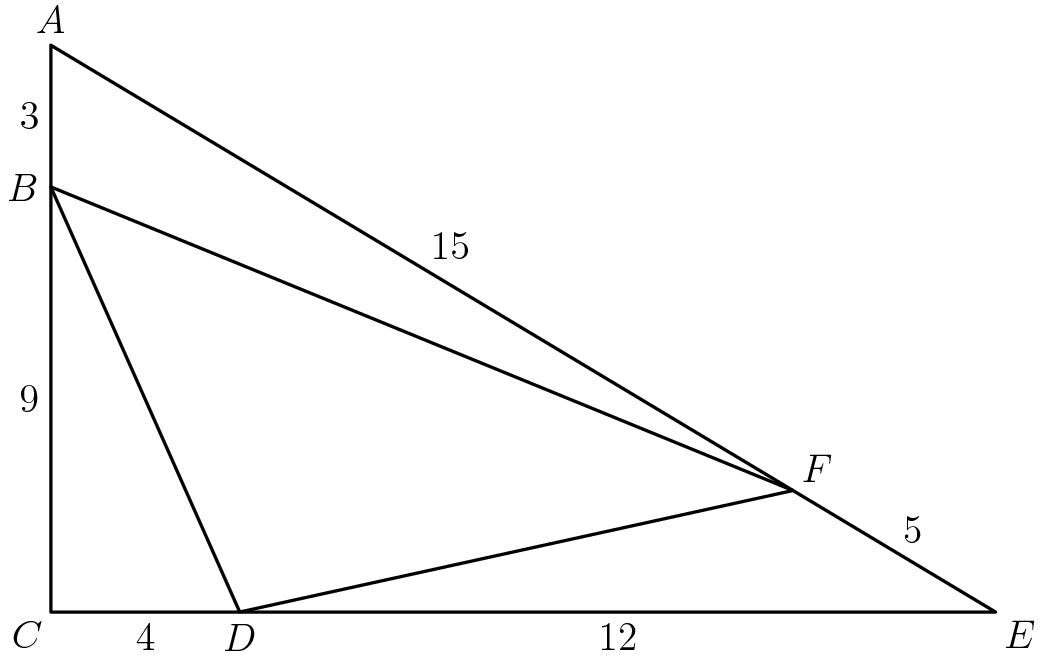
In the right triangle , we have , , and . Points , , and are located on , , and , respectively, so that , , and . What is the ratio of the area of to that of ?
Show solution without answering
Key insight
Find the middle triangle by cutting off the three corner triangles. Each corner triangle turns out to have area 18, and the big triangle has area 96.
Solution
The middle triangle is what is left of after cutting off three corner triangles: (at ), (at ) and (at ). So find those three areas and subtract.
1. The big triangle. Since , the right angle is at . Its area is .
2. Put it on a grid so heights are easy to read. Put at , at straight up, and at straight right.
- is on with , so is below : .
- is on with : .
- is on with , which is of . Going all the way from to moves left and up, so a quarter of the way moves left and up: .
3. Corner at : triangle has a right angle at , with legs and . Area .
4. Corner at : triangle . Use as the base; it lies on the vertical line . The height is how far is from that line, which is its -value, . Area .
5. Corner at : triangle . Use as the base; it lies on the bottom edge. The height is how high is, . Area .
6. Subtract: . (Here means the area of triangle .)
7. The ratio is
The answer is .
Why this works
A triangle drawn inside another, with its corners on the sides, is usually easiest to find by subtracting the corner pieces. For each corner piece, pick a base that lies along a side of the big triangle, and the height is just how far the third point is from that side. Here every side is split to , which is why all three corners come out equal.
Alternative approach
Two triangles that share a corner angle have areas in the same ratio as the products of the two sides at that angle. Triangle shares angle with , and uses of side and of side . So its area is of , which is . The same fractions appear at and at , so the middle triangle is of the whole.
Concise solution
A shorter write-up, the way contest solutions are usually written. It may take a different route from the solution above.
Triangle has a right angle at (since ), so its area is .
The three points cut each side in the ratio : , , . The middle triangle is what remains after removing the three corner triangles , , .
If two triangles share an angle, their areas are in the ratio of the products of the sides enclosing that angle (area ). Corner : triangle shares with , with and , so
The same fractions and appear at and at , so as well. (At this is also just .)
Therefore , and
The answer is .
Review in the AoPS books
- Introduction to Geometry, Chapter 4: Perimeter and Area (§4.2)
- Introduction to Geometry, Chapter 3: Congruent Triangles
- Introduction to Geometry, Chapter 6: Right Triangles (§6.1, §6.2, §6.3)
- Introduction to Geometry, Chapter 5: Similar Triangles
Similar problems
Problem © Mathematical Association of America (MAA), American Mathematics Competitions. Reproduced for non-commercial educational use. Solution and commentary are original to this site.