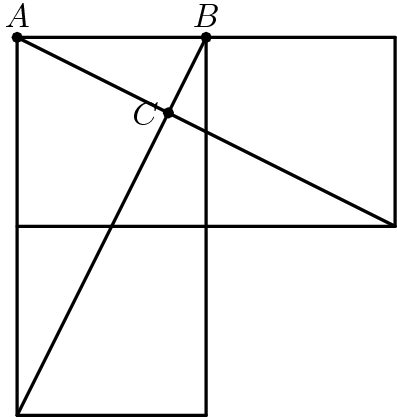
Three unit squares and two line segments connecting two pairs of vertices are shown. What is the area of ?
- A)
- B)
- C)
- D)
- E)
Answer
B
Key insight
AB is a unit base, so only the height of C is needed; the two segments have slopes -1/2 and 2, and they meet 2/5 below AB.
Solution
Place and , with the squares below the -axis: two side by side occupying , , and one more below the left square occupying , .
One segment runs from to the far corner ; its line is . The other runs from to the bottom corner ; its line has slope , so it is .
Point is where they meet:
Triangle has base and height equal to the distance from to line , which is . Its area is
The answer is .
Why this works
A figure built from unit squares is already a coordinate grid, so lines through grid vertices have simple equations and their intersection is a two-line solve. With a horizontal base, the area only needs the vertical distance of the third vertex. Read the figure carefully to get the right endpoints before writing any equations.
Alternative approach
Without coordinates: let be below and to the right of . Along , the drop is half the run, so ; along , the drop is twice the run, so . Then gives , , area .
The trap
Misreading which vertices the segments join (e.g. assuming the segments are diagonals of single squares) and getting a height of 1/2 or 1/3.
Common mistakes
- Misreading which vertices the segments join (e.g. assuming the segments are diagonals of single squares) and getting a height of 1/2 or 1/3.
- Using the slant lengths or as a height, which produces an answer involving .
Techniques
Place the figure on coordinates and compute