2024 AMC 10A Problem 22
Let be the kite formed by joining two right triangles with legs and along a common hypotenuse. Eight copies of are used to form the polygon shown below. What is the area of triangle ? 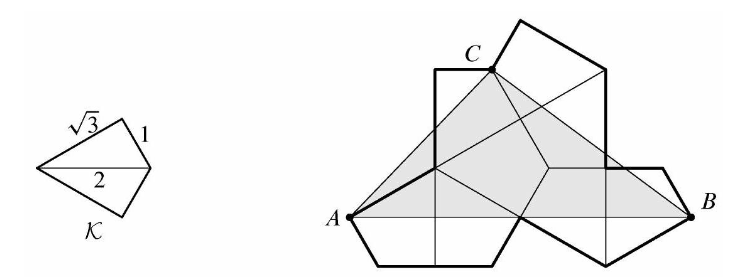
Show solution without answering
Key insight
Every kite corner is 60, 90 or 120 degrees, so all lengths come from 30-60-90 triangles: AB = 3 + 3 and C is 3√3/2 above AB.
Solution
Step 0: know the kite. Each half of the kite is a right triangle with legs and and hypotenuse : a -- triangle. Putting two together along the hypotenuse gives a kite with:
- a corner where the two sides meet,
- a corner where the two sides of length meet,
- two corners,
- a long diagonal of length joining the and corners, which cuts both of those angles in half.
From the corner, the two corners are away, and the corner is away.
Step 1: find the key point. Let be the corner of the outline where the thick edge from meets the vertical thick edge, below and to the left of . Four kites meet at , each with its corner there.
Step 2: the length of . Let be the point on segment between and where the outline touches it.
- The two kites just below have their corners at and at . So , and the angle is .
- Triangle has two sides with a angle between them. Cut it in half with a line from straight down to . Each half is a -- triangle with hypotenuse : its short side (the height) is and its long side is . So , and is above .
- The same thing happens at the lowest corner on the right, below between and : two kites meet there with corners and have corners at and . So as well.
- So .
Step 3: the height of above .
- is the corner of the kite whose corner is at and which lies against the vertical edge. So is that kite's long diagonal, with length .
- This kite's corner sits between the vertical edge (straight up) and an edge to the right of it. The diagonal cuts that corner in half, so is from vertical, which is above horizontal.
- So , and the point level with below form a -- triangle with hypotenuse . The side across from is , so is above .
- Height of above : .
Step 4: the area.
The answer is .
Why this works
Every edge of the figure is or and every angle is a multiple of , so all the distances you need come from -- triangles (sides in the ratio ). The work is in reading the picture: find where the kites' corners meet, and the base and height fall out from there.
Alternative approach
Use coordinates, with at and horizontal. From the steps above, , , , and (it is units from in the direction above horizontal). The base runs from to , so it is long. is above the line . The area is .
Concise solution
A shorter write-up, the way contest solutions are usually written. It may take a different route from the solution above.
Gluing two –– triangles along the hypotenuse gives a kite with a corner (where the two sides meet), a corner (where the two unit sides meet), and two right angles. Its long diagonal is the hypotenuse, length , bisecting the and corners.
Let be the polygon vertex below and to the left of , where the thick edge from meets the vertical thick edge. Four kites meet at with their corners.
Length of . Let be the point where the boundary touches between and . The two kites below have right-angle corners and , so and . An isosceles triangle with legs and apex has base and height , so . At the lowest right vertex , two kites meet at corners with right-angle corners and , so likewise. Both bases are horizontal (perpendicular to vertical bisectors), so .
Height of . is the corner of the kite whose corner is , so is that kite's long diagonal, bisecting the angle between the vertical edge at and the edge rising at . Hence makes with the horizontal, is above , and is above : total height .
The answer is .
Review in the AoPS books
- Introduction to Geometry, Chapter 4: Perimeter and Area (§4.2)
- Introduction to Geometry, Chapter 2: Angles
- Introduction to Geometry, Chapter 17: Analytic Geometry (§17.4, §17.6)
- Introduction to Geometry, Chapter 6: Right Triangles (§6.1, §6.2, §6.3)
Similar problems
Problem © Mathematical Association of America (MAA), American Mathematics Competitions. Reproduced for non-commercial educational use. Solution and commentary are original to this site.