2008 AMC 10A Problem 21
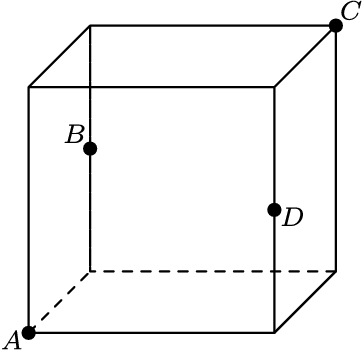
A cube with side length is sliced by a plane that passes through two diagonally opposite vertices and and the midpoints and of two opposite edges not containing or , as shown. What is the area of quadrilateral ?
Show solution without answering
Key insight
All four sides of ABCD are equal, so it is a rhombus. Its diagonals are the cube diagonal, root 3, and a face diagonal length, root 2.
Solution
Give each corner of the cube coordinates, so every length becomes a quick calculation. Let the cube have corners at and in each direction.
1. Put . The opposite corner is .
2. Two opposite edges that miss both and are the upright edge from to and the upright edge from to . Their midpoints are
3. The sides. Use the distance formula (the Pythagorean theorem in three directions):
In the same way, , and each have one difference of , one of and one of , so they all equal . Four equal sides make a rhombus.
4. The diagonals. goes from one corner of the cube to the opposite corner:
goes from to :
5. The area of a rhombus is half the product of its diagonals:
The answer is .
Why this works
Coordinates turn a hard-to-picture 3D shape into a few distance calculations. Once you see the four sides are equal, you know it is a rhombus, and a rhombus is easiest to measure by its diagonals. Here the diagonals are two lengths worth knowing in a unit cube: corner to opposite corner is , and across a face is .
Alternative approach
Cut the rhombus along into two equal triangles, each with base . The diagonals of a rhombus cross at right angles and cut each other in half, so the height of each triangle is half of , which is . Each triangle has area , and the two together make .
Concise solution
A shorter write-up, the way contest solutions are usually written. It may take a different route from the solution above.
Place the cube as with and the opposite vertex . The two opposite edges avoiding and can be taken as the vertical edges above and , with midpoints
Compute the four sides:
and by the same arithmetic . So is a rhombus (it is planar because , i.e. the diagonals share a midpoint).
Its diagonals are the space diagonal and
A rhombus has area half the product of its diagonals:
The answer is .
Review in the AoPS books
- Introduction to Geometry, Chapter 14: Three-Dimensional Geometry
- Introduction to Geometry, Chapter 8: Quadrilaterals
- Introduction to Algebra, Chapter 22: Special Manipulations (§22.3)
- Introduction to Geometry, Chapter 17: Analytic Geometry (§17.4, §17.6)
Similar problems
Problem © Mathematical Association of America (MAA), American Mathematics Competitions. Reproduced for non-commercial educational use. Solution and commentary are original to this site.