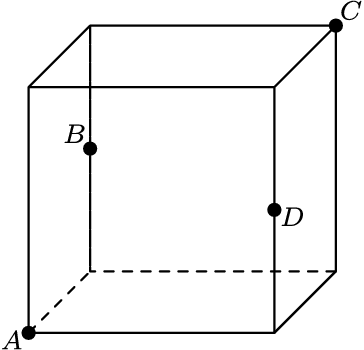
A cube with side length is sliced by a plane that passes through two diagonally opposite vertices and and the midpoints and of two opposite edges not containing or , as shown. What is the area of quadrilateral ?
- A)
- B)
- C)
- D)
- E)
Answer
A
Key insight
ABCD is a rhombus: all four sides are half a face diagonal's worth, sqrt(5)/2, and its diagonals are the space diagonal sqrt(3) and the midpoint-to-midpoint segment sqrt(2).
Solution
Place the cube as with and the opposite vertex . The two opposite edges avoiding and can be taken as the vertical edges above and , with midpoints
Compute the four sides:
and by the same arithmetic . So is a rhombus (it is planar because , i.e. the diagonals share a midpoint).
Its diagonals are the space diagonal and
A rhombus has area half the product of its diagonals:
The answer is .
Why this works
The cube's symmetry (a half-turn about the axis through and swaps and ) forces the cross-section to be a rhombus, and a rhombus is easiest to measure by its diagonals, which here are two "famous" cube lengths. Coordinates make the distance computations mechanical and confirm the planarity. Slicing a cube through opposite vertices and edge midpoints is a classic configuration worth remembering.
Alternative approach
Split the rhombus along into two congruent triangles with base . The distance from to line is half of , namely , so each triangle has area , and the total is .
The trap
Treating the cross-section as a square or rectangle and multiplying two sides, rather than using the diagonals of a rhombus.
Common mistakes
- Treating the cross-section as a square or rectangle and multiplying two sides, rather than using the diagonals of a rhombus.
- Taking (the edge length) instead of ; and sit on opposite edges, so they differ in two coordinates.
Techniques
Place the figure on coordinates and compute · Exploit symmetry to reduce work or pair up objects