2007 AMC 10A Problem 15
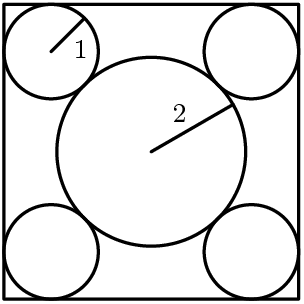
Four circles of radius are each tangent to two sides of a square and externally tangent to a circle of radius , as shown. What is the area of the square?
Show solution without answering
Key insight
Walk along a diagonal from the center to a corner: 2 + 1 = 3 to a small circle's center, then the diagonal of a 1-by-1 square to the corner.
Solution
By symmetry the big circle is at the center of the square, and each small circle sits in a corner, with its center on a diagonal. So measure half of one diagonal, piece by piece.
1. Center of square to center of a small circle. The circles just touch, so the distance between centers is the sum of the radii: .
2. Center of the small circle to the corner. The small circle touches both sides at that corner, so its center is away from each side. The center and the corner are opposite corners of a square, so this distance is .
3. Half the diagonal is , so the whole diagonal is .
4. Side of the square. A square's diagonal is its side times , so
5. Area.
The answer is .
Why this works
Every "tangent" in the problem turns into a distance: two touching circles have centers apart by the sum of their radii, and a circle touching a side has its center one radius from that side. Lining these pieces up along a line of symmetry, here the diagonal, turns the picture into a single sum.
Alternative approach
Join the four small centers; they form a smaller square with the same center. Its diagonal runs from one small center through the big circle to the opposite small center: . So its side is . The big square sticks out by one radius () on each side, so its side is and its area is .
Concise solution
A shorter write-up, the way contest solutions are usually written. It may take a different route from the solution above.
By symmetry the big circle sits at the center of the square and each small circle's center lies on a diagonal. Trace one diagonal from the center to a corner.
From the center to a small circle's center: the circles are externally tangent, so this distance is .
From the small circle's center to the corner: the small circle is tangent to both sides meeting at that corner, so its center is unit from each side, i.e. at the far vertex of a square in the corner. That distance is .
Half the diagonal is , so the full diagonal is and the side is
The area is
The answer is .
Review in the AoPS books
- Introduction to Geometry, Chapter 11: Circles
- Introduction to Geometry, Chapter 8: Quadrilaterals
- Introduction to Geometry, Chapter 19: Problem Solving Strategies in Geometry (§19.1)
- Introduction to Geometry, Chapter 4: Perimeter and Area (§4.2, §4.3)
Similar problems
Problem © Mathematical Association of America (MAA), American Mathematics Competitions. Reproduced for non-commercial educational use. Solution and commentary are original to this site.