2003 AMC 10B Problem 19
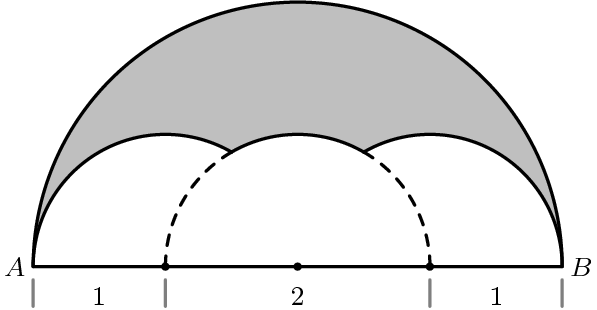
Three semicircles of radius are constructed on diameter of a semicircle of radius . The centers of the small semicircles divide into four line segments of equal length, as shown. What is the area of the shaded region that lies within the large semicircle but outside the smaller semicircles?
Show solution without answering
Key insight
Neighboring small semicircles cross at a point 1 away from both centers, forming equilateral triangles. The white part is two triangles plus slices totaling 5/6 of a circle.
Solution
1. Set up the picture. , and the small centers split it into four pieces of length . Call the small centers , , from left to right; is also the center of the big semicircle.
2. The shaded part is the big semicircle minus the white part (everything covered by the three small semicircles). The big semicircle has area . So we need the white area.
3. The left and middle small semicircles cross at a point . Since is on both, and . Also . So triangle has all sides : it is equilateral, and all its angles are . In the same way the middle and right semicircles cross at , and triangle is equilateral.
4. The left and right semicircles only touch at the point , so there is no other overlap.
5. Draw the segments , , , . They cut the white region into pieces that are easy to measure:
- Left semicircle, the slice from around to : the angle at is , which is of a full circle, so area .
- Middle semicircle, the slice between and : the angle at is , which is of a circle, so area .
- Right semicircle, the slice from around to : again , area .
- Two equilateral triangles of side , each with area .
6. White area:
7. Shaded area:
The answer is .
Why this works
When two circles of the same radius have centers one radius apart, the crossing point forms an equilateral triangle with the two centers, so every angle is a multiple of . Drawing lines from crossing points to the centers is the standard move for overlapping circles: it cuts a curvy region into pie slices and triangles, which you can measure.
Alternative approach
Add the three small semicircles and take away the overlaps. Together they have area . Each overlap (between 's and 's semicircles, and between 's and 's) is a slice from each circle minus the equilateral triangle they share: . So the white area is , the same as before.
Concise solution
A shorter write-up, the way contest solutions are usually written. It may take a different route from the solution above.
Put the large center at and the small centers at , , with . The left and middle small semicircles meet at a point with , so triangle is equilateral; similarly the middle and right ones meet at with equilateral. The outer two semicircles only touch at , so there are no other overlaps.
Draw . The white region (the union of the three small semicircles) splits into:
- sector of the left semicircle from ray (at ) around to : , area ;
- sector of the middle semicircle between rays and : , area ;
- sector of the right semicircle from around to ray : , area ;
- the two equilateral triangles and of side , area each.
White area: .
The large semicircle has area , so the shaded area is
The answer is .
Review in the AoPS books
- Introduction to Geometry, Chapter 11: Circles
- Introduction to Geometry, Chapter 8: Quadrilaterals
- Introduction to Geometry, Chapter 19: Problem Solving Strategies in Geometry (§19.1)
- Introduction to Geometry, Chapter 4: Perimeter and Area (§4.2, §4.3)
Similar problems
Problem © Mathematical Association of America (MAA), American Mathematics Competitions. Reproduced for non-commercial educational use. Solution and commentary are original to this site. Also appeared as 2003 12B #16.