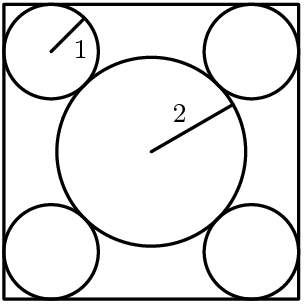
Four circles of radius are each tangent to two sides of a square and externally tangent to a circle of radius , as shown. What is the area of the square?
- A)
- B)
- C)
- D)
- E)
Answer
B
Key insight
Along a diagonal of the square, center to small-circle center is 2 + 1 = 3 and small-circle center to corner is sqrt(2), so the half-diagonal is 3 + sqrt(2).
Solution
By symmetry the big circle sits at the center of the square and each small circle's center lies on a diagonal. Trace one diagonal from the center to a corner.
From the center to a small circle's center: the circles are externally tangent, so this distance is .
From the small circle's center to the corner: the small circle is tangent to both sides meeting at that corner, so its center is unit from each side, i.e. at the far vertex of a square in the corner. That distance is .
Half the diagonal is , so the full diagonal is and the side is
The area is
The answer is .
Why this works
Tangency statements translate into center distances: externally tangent circles have centers separated by the sum of the radii, and a circle tangent to two perpendicular sides has its center from each. Lining these pieces up along a line of symmetry (here the diagonal) converts the whole picture into a single one-dimensional sum.
Alternative approach
Connect the four small centers: they form a square whose diagonal is , so its side is . The big square is wider by one radius on each side, so its side is , and its area is .
The trap
Taking the distance from a small circle's center to the corner as 1 (the radius) instead of sqrt(2), the diagonal of a 1-by-1 square.
Common mistakes
- Taking the distance from a small circle's center to the corner as (the radius) instead of , the diagonal of a -by- square.
- Squaring incorrectly (dropping the cross term ) and picking a choice without a radical.
Techniques
Add construction lines/points (drop altitudes, extend segments, connect centers) · Cut the figure into known shapes (triangles, rectangles, sectors)