Points and are located on square so that is equilateral. What is the ratio of the area of to that of ?
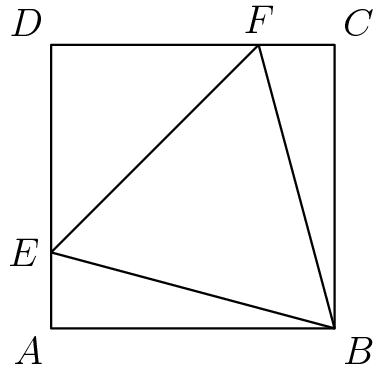
- A)
- B)
- C)
- D)
- E)
Answer
D
Key insight
Symmetry gives AE = CF = t; equating BE^2 = 1 + t^2 with EF^2 = 2(1 - t)^2 yields (1 - t)^2 = 2t, so the ratio is 2.
Solution
Let the square have side , with on and on , and put .
Right triangles and have equal legs and equal hypotenuses , so they are congruent (hypotenuse-leg). Hence as well, and .
Now express the equilateral side two ways. From right triangle : . From right isosceles triangle : . Setting them equal,
We do not need itself. Rewrite the relation as . Then
The areas are and . Their ratio is
The answer is .
Why this works
The figure is symmetric about diagonal , which makes an isosceles right triangle and reduces everything to one unknown. The equilateral condition then becomes a single Pythagorean equation. The final trick is common on the AMC: when a ratio is requested, manipulate the defining relation to get the ratio directly rather than solving for and substituting radicals.
Alternative approach
Angle chase: symmetry gives , so . Then and , giving the same ratio .
The trap
Expecting an answer involving sqrt(3) because the triangle is equilateral, and picking (C) or (E) without computing.
Common mistakes
- Expecting an answer involving sqrt(3) because the triangle is equilateral, and picking (C) or (E) without computing.
- Solving the quadratic and taking the root , which exceeds the side of the square.
Techniques
Apply an identity: SFFT, sum of squares, difference of cubes, Vieta · Exploit symmetry to reduce work or pair up objects