2004 AMC 10A Problem 19
A white cylindrical silo has a diameter of 30 feet and a height of 80 feet. A red stripe with a horizontal width of 3 feet is painted on the silo, as shown, making two complete revolutions around it. What is the area of the stripe in square feet?
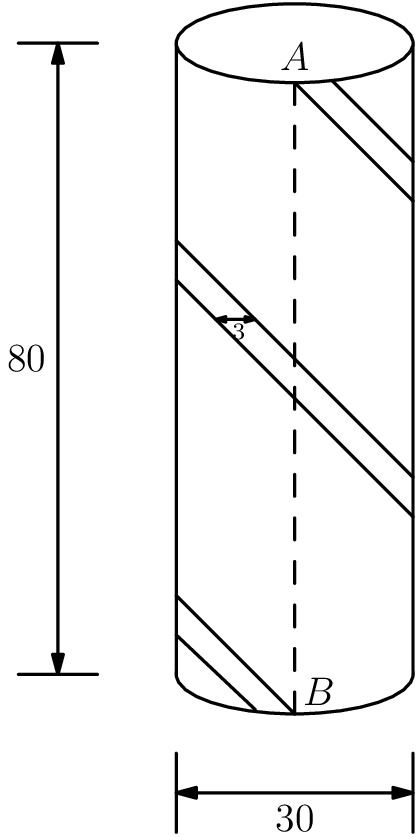
Show solution without answering
Key insight
Unroll the silo into a flat rectangle. The stripe becomes slanted strips 3 feet wide climbing 80 feet in total, so its area is 3 times 80.
Solution
1. Cut the side of the silo straight down and flatten it out, like peeling a label off a can. Flattening does not stretch anything, so the stripe keeps its area.
2. The flat piece is a rectangle feet tall. On it, the stripe becomes slanted strips.
3. Look at the stripe at any height. Going straight across, it is always feet wide.
4. The stripe goes around twice, so it becomes two slanted strips, each rising feet. Each strip is a parallelogram with a base of (measured straight across) and a height of (measured straight up).
5. A parallelogram's area is base times height, so each strip has area . The two together:
The answer is .
Why this works
The side of a cylinder can be unrolled into a flat rectangle without changing any areas, which turns a 3-D question into a flat one. A slanted strip is a parallelogram, and sliding it sideways into a straight rectangle does not change its area: width times total height . The diameter and the number of turns are extra information, and noticing that is part of the lesson.
Concise solution
A shorter write-up, the way contest solutions are usually written. It may take a different route from the solution above.
Cut the silo's curved surface along a vertical line and flatten it. The surface becomes a rectangle feet wide and feet tall, and distances along the surface are unchanged, so the stripe's area is preserved.
In the flattened picture the stripe is a slanted band whose horizontal cross-section at every height is a segment of length . Each revolution of the stripe is a parallelogram with horizontal base and vertical height (two revolutions span the -foot height). The area of a parallelogram is base times perpendicular height, so each piece has area , and the two pieces together have area
Equivalently, sweeping a horizontal segment of length through a vertical distance of covers area regardless of how the band slants.
The answer is .
Review in the AoPS books
- Introduction to Geometry, Chapter 14: Three-Dimensional Geometry
- Introduction to Geometry, Chapter 8: Quadrilaterals
- Introduction to Geometry, Chapter 4: Perimeter and Area (§4.2, §4.3)
- Introduction to Geometry, Chapter 15: Curved Surfaces
Similar problems
Problem © Mathematical Association of America (MAA), American Mathematics Competitions. Reproduced for non-commercial educational use. Solution and commentary are original to this site.