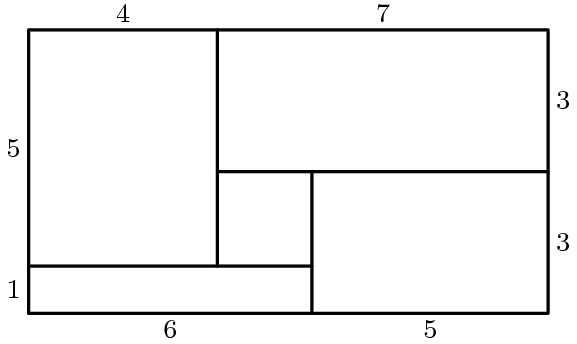
Rose fills each of the rectangular regions of her rectangular flower bed with a different type of flower. The lengths, in feet, of the rectangular regions in her flower bed are as shown in the figure. She plants one flower per square foot in each region. Asters cost $11.5022.503$ each. What is the least possible cost, in dollars, for her garden?
- A)
- B)
- C)
- D)
- E)
Answer
A
Key insight
Read the five rectangle areas off the figure (21, 20, 15, 6, 4), then pair the cheapest flower with the largest region and so on down.
Solution
The whole bed is feet wide () and feet tall (). Its five rectangular regions have dimensions
- top right: , area ;
- upper left: , area ;
- lower right: , area ;
- bottom strip: , area ;
- the leftover middle piece: , area .
Check: , the area of the whole bed.
Each region gets one kind of flower, one plant per square foot. To make the total as small as possible, the cheapest flower should cover the most ground and the most expensive the least, so match prices with areas in that order:
The answer is .
Why this works
Minimizing over all pairings is the rearrangement principle: sort one list ascending and the other descending. If any two flowers were "out of order," swapping them would lower the cost, so the sorted pairing is optimal. The only real work is reading the unlabeled lengths correctly from the figure and checking they tile the whole bed.
The trap
Misreading the dimensions of a region from the figure (the middle 2-by-2 square is easy to miss) or matching costs to areas in the wrong order.
Common mistakes
- Misreading the dimensions of a region from the figure (the middle square is easy to miss) or matching costs to areas in the wrong order.
- Pairing the cheapest flower with the smallest region, which gives the maximum cost , choice (E).
Techniques
Set up the equation/formula and compute; no special trick needed · Consider the largest/smallest element or boundary case