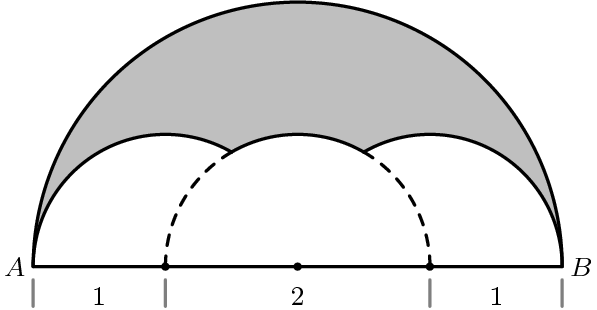
Three semicircles of radius are constructed on diameter of a semicircle of radius . The centers of the small semicircles divide into four line segments of equal length, as shown. What is the area of the shaded region that lies within the large semicircle but outside the smaller semicircles?
- A)
- B)
- C)
- D)
- E)
Answer
E
Key insight
Join each intersection point of neighboring small semicircles to the two centers: the white region becomes two equilateral triangles plus sectors totaling 5/6 of a unit circle.
Solution
Put the large center at and the small centers at , , with . The left and middle small semicircles meet at a point with , so triangle is equilateral; similarly the middle and right ones meet at with equilateral. The outer two semicircles only touch at , so there are no other overlaps.
Draw . The white region (the union of the three small semicircles) splits into:
- sector of the left semicircle from ray (at ) around to : , area ;
- sector of the middle semicircle between rays and : , area ;
- sector of the right semicircle from around to ray : , area ;
- the two equilateral triangles and of side , area each.
White area: .
The large semicircle has area , so the shaded area is
The answer is .
Why this works
Two unit circles whose centers are one unit apart intersect at the third vertex of an equilateral triangle, so all the angles are multiples and every piece is a sector or an equilateral triangle. Connecting intersection points to centers is the standard move for overlapping circles: it exposes the radii and turns a curvy region into sectors plus triangles.
Alternative approach
Inclusion-exclusion: the three semicircles have total area ; each of the two overlaps is half a lens of two unit circles at distance , i.e. . White area , as before.
The trap
Adding the three small semicircle areas (3pi/2) without subtracting their overlaps, which gives pi/2 and no listed answer, or double-counting the overlap.
Common mistakes
- Adding the three small semicircle areas () without subtracting their overlaps, which gives and no listed answer, or double-counting the overlap.
- Treating the lens between two neighboring semicircles as a full lens () instead of the half that lies above .
Techniques
Add construction lines/points (drop altitudes, extend segments, connect centers) · Cut the figure into known shapes (triangles, rectangles, sectors)