2003 AMC 10B Problem 20
In rectangle and . Points and are on so that and . Lines and intersect at . Find the area of .
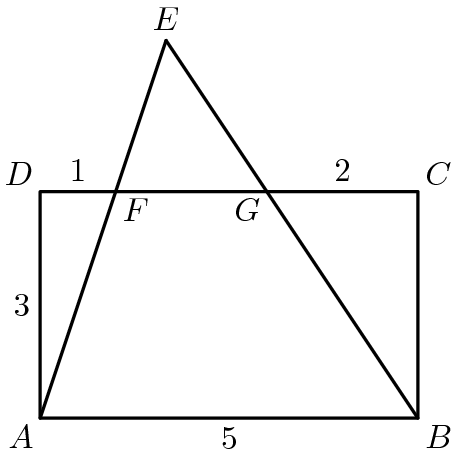
Show solution without answering
Key insight
FG = 2 is parallel to AB = 5, so the top triangle is a 2/5 copy of triangle AEB. Their heights differ by 3, so the height is 5.
Solution
1. The area of triangle is , where the height is the distance from down to . So we need that height; call it .
2. Side is also . Taking away and leaves .
3. lies on the top side of the rectangle, parallel to . So triangle (the small triangle above the rectangle) has the same angles as triangle . It is a shrunken copy, and the shrink factor is .
4. In a shrunken copy, every length shrinks by the same factor, including the height. The big triangle has height . The small triangle's height is the part above the rectangle, . So
5. Cross-multiply: , so , , and .
6. Area:
The answer is .
Why this works
A line parallel to one side of a triangle cuts off a smaller triangle of the same shape, and in two triangles of the same shape all lengths, heights included, are in the same ratio. The rectangle's height is exactly the difference of the two heights, which pins down the size. Look for this "small triangle on top of a big one" picture whenever two lines cross a pair of parallel lines.
Alternative approach
Use coordinates: , , , . Line goes up for every across, so it is . Line goes from to , up for every to the left, so . Setting them equal: , so and . Then , so the height is and the area is .
Concise solution
A shorter write-up, the way contest solutions are usually written. It may take a different route from the solution above.
Since , the segment has length . Because , triangles and are similar (equal corresponding angles), with ratio .
Let be the distance from to line . The distance from to line is then , and the similarity ratio applies to these heights:
Therefore
The answer is .
Review in the AoPS books
- Introduction to Geometry, Chapter 3: Congruent Triangles
- Introduction to Geometry, Chapter 4: Perimeter and Area (§4.2)
- Introduction to Geometry, Chapter 5: Similar Triangles
- Introduction to Geometry, Chapter 6: Right Triangles (§6.1, §6.2, §6.3)
Similar problems
Problem © Mathematical Association of America (MAA), American Mathematics Competitions. Reproduced for non-commercial educational use. Solution and commentary are original to this site. Also appeared as 2003 12B #14.