2003 AMC 10A Problem 22
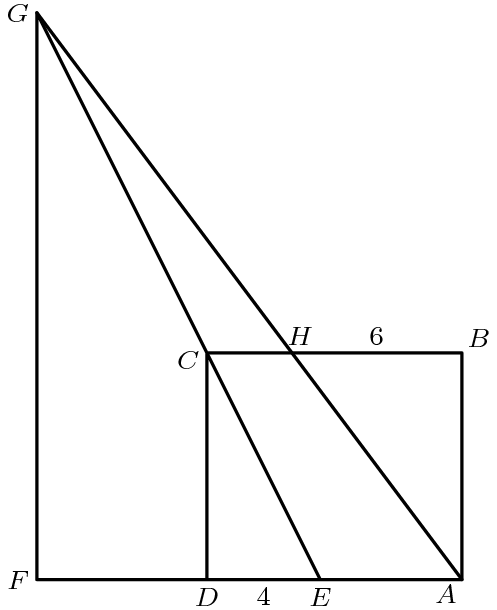
In rectangle , we have , , is on with , is on with , line intersects line at , and is on line with . Find the length of .
Show solution without answering
Key insight
G sits above two parallel sides. The triangles from G to each side have the same shape, with bases 3 and 5, and heights differing by 8.
Solution
The point lies outside the rectangle, beyond side . Lines from cross the two parallel sides and , and that always creates two triangles with the same shape. Use them.
1. The pieces of the sides. . Then and .
2. Two triangles of the same shape. Look at triangle (small, with base on line ) and triangle (large, with base on line ). They share the angle at , and because is parallel to , their bases are parallel. So the small triangle is a shrunken copy of the large one, and every length in it is of the matching length in the large one.
3. The heights. The height of the large triangle from down to line is exactly . The height of the small triangle from down to line is of that, so it is .
4. The gap between the heights. Both heights are measured straight down from , and line sits above line . So the large height is more than the small one:
5. Solve. , so .
The answer is .
Why this works
Two lines through one point that cross a pair of parallel lines always make two triangles of the same shape, and every length (sides and heights alike) scales by the same factor. Here the factor comes from the bases, and , and the rectangle tells you the two heights differ by . Setting "big height minus small height " finishes it.
Alternative approach
Use coordinates. Put , , , . Then and .
- Line goes from to : it drops over a run of , so .
- Line goes from to : slope , so .
Setting them equal: gives , so and . The point is above line (the -axis), so .
Concise solution
A shorter write-up, the way contest solutions are usually written. It may take a different route from the solution above.
From the rectangle, and .
Since , the lines and cut the two parallels in similar triangles: with ratio .
Extend line until it meets line at a point . Because is perpendicular to , it is perpendicular to as well, so and are the altitudes from of the two similar triangles, and equals the distance between the parallel sides, .
Corresponding altitudes are in the similarity ratio:
So , giving and .
The answer is .
Review in the AoPS books
- Introduction to Geometry, Chapter 3: Congruent Triangles
- Introduction to Geometry, Chapter 19: Problem Solving Strategies in Geometry (§19.1)
- Introduction to Geometry, Chapter 17: Analytic Geometry (§17.4, §17.6)
- Introduction to Geometry, Chapter 5: Similar Triangles
Similar problems
Problem © Mathematical Association of America (MAA), American Mathematics Competitions. Reproduced for non-commercial educational use. Solution and commentary are original to this site.