2025 AMC 10A Problem 15
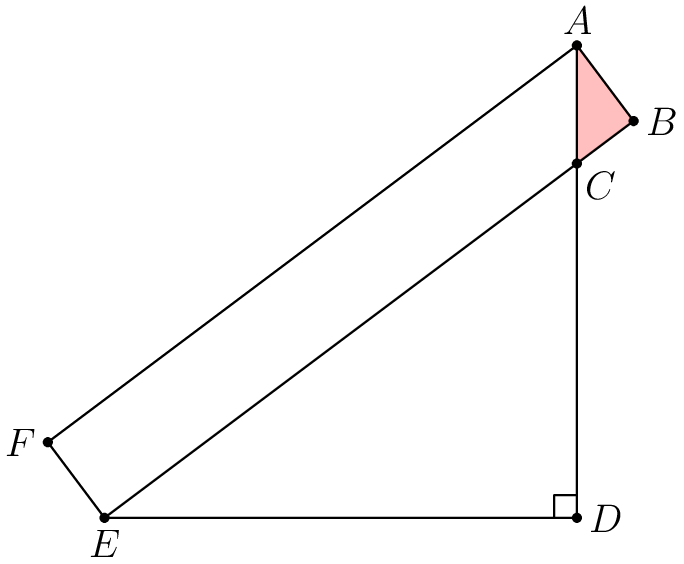
In the figure below, is a rectangle, , , , and . What is the area of ?
Show solution without answering
Key insight
Draw AE. It is the hypotenuse of both right triangles ABE and ADE, so DE = 5. Then triangles ABC and EDC are similar, with EDC five times bigger.
Solution
In the figure, is the point where segment crosses segment .
Triangle has a right angle at , because is a corner of the rectangle. So its area is
Everything comes down to finding .
Step 1: connect the two parts of the figure. The facts come in two separate groups: the rectangle (, ) and the right angle at (). The segment belongs to both groups, so draw it.
1. In the rectangle, opposite sides are equal, so . Triangle has a right angle at , so by the Pythagorean theorem
2. Triangle has a right angle at , and is its hypotenuse too. So
Step 2: find similar triangles. Look at the two triangles that meet at : triangle (top) and triangle (bottom).
3. Both have a right angle: at and at .
4. The angles at are equal, because two straight lines cross there (vertical angles).
5. So the triangles are similar. Match the corners: , , . The side matches , so triangle is times as big as triangle .
6. Matching the other sides with the same corner order:
- matches , so .
- matches , so .
Step 3: use the pieces of the two segments. splits each segment into two pieces:
Replace and using Step 2:
- From the first equation, .
- Put that into the second: , so , which gives and .
- Quick check: , and . Triangle really is a right triangle with these sides.
So the area is .
The answer is .
Why this works
When a figure gives you two groups of facts that seem unrelated, look for a segment they share; here is the hypotenuse of two right triangles, and computing it both ways uncovers . After that, two lines crossing at a point almost always give a pair of similar triangles. Writing "piece + piece = whole" for each crossing segment turns the picture into two simple equations.
Alternative approach
Once you know (Step 2), you can use the Pythagorean theorem in triangle instead of the second equation.
Let . Then and . Triangle has legs and and hypotenuse :
Expand: , so , or . This factors as , so or .
If , then is negative, which is impossible. So and the area is . This way needs a quadratic, which is why the main solution uses the second segment instead.
Concise solution
A shorter write-up, the way contest solutions are usually written. It may take a different route from the solution above.
In the figure is the point where crosses , so has the right angle of the rectangle at and
Everything reduces to finding .
Step 1: the diagonal . In rectangle , and , so
Step 2: the length . Since and ,
Step 3: similar triangles. Triangles and have right angles at and at , and because are collinear and are collinear, making these vertical angles. So
Corresponding sides give
Step 4: solve. The point lies on both segments, so and . Substituting,
From the first, ; putting that into the second,
Therefore
The answer is .
Review in the AoPS books
- Introduction to Geometry, Chapter 3: Congruent Triangles
- Introduction to Geometry, Chapter 4: Perimeter and Area (§4.2)
- Introduction to Geometry, Chapter 19: Problem Solving Strategies in Geometry (§19.1)
- Introduction to Geometry, Chapter 5: Similar Triangles
Similar problems
Problem © Mathematical Association of America (MAA), American Mathematics Competitions. Reproduced for non-commercial educational use. Solution and commentary are original to this site.