2003 AMC 10A Problem 23
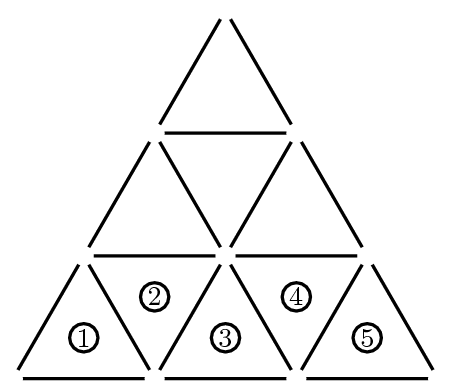
A large equilateral triangle is constructed by using toothpicks to create rows of small equilateral triangles. For example, in the figure, we have rows of small congruent equilateral triangles, with small triangles in the base row. How many toothpicks would be needed to construct a large equilateral triangle if the base row of the triangle consists of small equilateral triangles?
Show solution without answering
Key insight
Every toothpick is a side of exactly one upward-pointing small triangle. Count those, 1 + 2 + ... + 1002, and multiply by 3.
Solution
Toothpicks are shared between neighboring triangles, so counting "3 per triangle" would count many twice. Find a way to give each toothpick to exactly one triangle.
1. Count the rows. In the picture the rows have , , small triangles: row has . A bottom row of triangles means , so there are rows.
2. Up and down triangles. In each row the triangles alternate pointing up and pointing down, starting and ending with up. Row has up-triangles and down-triangles. (Row in the picture: up and down, which makes .)
3. Each toothpick belongs to one up-triangle. Look at the picture. Every horizontal toothpick is the bottom edge of an up-triangle. Every slanted toothpick is the left or right side of an up-triangle. The down-triangles have no toothpicks of their own: their three sides are borrowed from the up-triangles around them. And no two up-triangles share a side.
4. So toothpicks (number of up-triangles). Check on the picture: up-triangles, and toothpicks, which matches counting them directly.
5. Count up-triangles for rows.
6. Toothpicks. .
The answer is .
Why this works
When pieces are shared between shapes, look for a family of shapes that uses every piece exactly once. Here the up-pointing triangles do that, so the count becomes a single multiplication. Testing the rule on the small picture first catches the two usual mistakes: miscounting the rows and counting inside edges twice.
Alternative approach
Count small cases and look for the pattern. With rows you need toothpicks, which is times (the sums , , , ). For rows that is . You do not even need to finish the multiplication: ends in , and only choice (C) ends in .
Concise solution
A shorter write-up, the way contest solutions are usually written. It may take a different route from the solution above.
Row from the top contains small triangles: of them point up and point down. A base row of triangles means there are rows.
Look only at the upward-pointing triangles. Each toothpick in the figure is a side of exactly one of them: the horizontal toothpicks are the bottoms of upward triangles, and the slanted toothpicks are their left or right sides. (A downward triangle borrows all three of its sides from neighboring upward triangles.) So no toothpick is counted twice if we count three per upward triangle.
Number of upward triangles: .
Toothpicks: .
Check on the given figure ( rows): toothpicks, which matches a direct count.
The answer is .
Review in the AoPS books
- Introduction to Counting & Probability, Chapter 1: Counting Is Arithmetic
- Introduction to Algebra, Chapter 21: Sequences & Series (§21.1, §21.2, §21.3, §21.4)
- Intermediate Counting & Probability, Chapter 4: Constructive Counting and 1-1 Correspondences (§4.4, §4.5, §4.6)
- Prealgebra, Chapter 15: Problem-Solving Strategies (§15.1)
Similar problems
Problem © Mathematical Association of America (MAA), American Mathematics Competitions. Reproduced for non-commercial educational use. Solution and commentary are original to this site.