2003 AMC 10A Problem 19
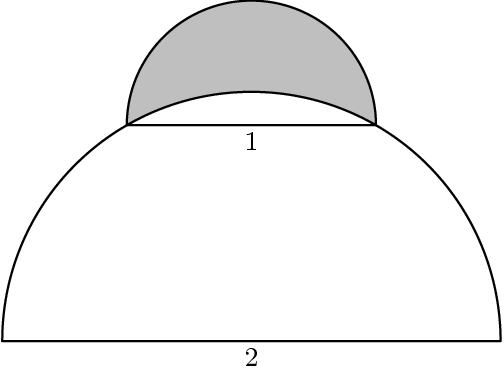
A semicircle of diameter sits at the top of a semicircle of diameter , as shown. The shaded area inside the smaller semicircle and outside the larger semicircle is called a lune. Determine the area of this lune.
Show solution without answering
Key insight
The lune is the small half-circle minus the piece of the big circle above its diameter. That piece is a 60 degree slice minus an equilateral triangle of side 1.
Solution
The lune is the small half-circle with a piece cut out, where the big half-circle overlaps it. So find the small half-circle's area and the overlap's area.
1. Small half-circle. Its diameter is , so its radius is and its area is
2. Where they overlap. The small half-circle sits on a flat segment of length whose ends lie on the big circle. The overlap is the part of the big circle between that segment and the big arc.
3. Find the angle. Let be the center of the big circle, so (its radius). Also . All three sides of triangle are , so it is equilateral and the angle at is .
4. Area of the overlap. The slice of the big circle (from out to the arc ) is made of the triangle plus the overlap. So
- Slice: .
- Equilateral triangle of side : .
- Overlap: .
5. Lune.
The answer is .
Why this works
Shapes bounded by two circle arcs break into slices, triangles, and the pieces between a straight segment and an arc (a slice minus a triangle). The helpful extra lines are radii to the ends of the segment, which reveal the angle. A segment equal in length to the radius always makes an equilateral triangle and a angle.
Alternative approach
Check the choices by size. The lune is part of the small half-circle, so its area is positive and less than . Choice (A) is about , and (D) and (E) are bigger than , so they are out. That leaves (B), about , and (C), about . The overlap computed above settles it as (C).
Concise solution
A shorter write-up, the way contest solutions are usually written. It may take a different route from the solution above.
The small semicircle has radius , so its area is .
The lune is what remains of the small semicircle after removing the part that overlaps the big semicircle. That overlap is the region of the big circle (radius ) lying above the chord that serves as the small semicircle's diameter: a circular segment.
Join the big circle's center to the two endpoints of that chord. Then and , so triangle is equilateral and . Therefore
Lune .
The answer is .
Review in the AoPS books
- Introduction to Geometry, Chapter 11: Circles
- Introduction to Geometry, Chapter 4: Perimeter and Area (§4.2)
- Introduction to Geometry, Chapter 19: Problem Solving Strategies in Geometry (§19.1)
- Introduction to Geometry, Chapter 12: Circles and Angles
Similar problems
Problem © Mathematical Association of America (MAA), American Mathematics Competitions. Reproduced for non-commercial educational use. Solution and commentary are original to this site. Also appeared as 2003 12A #15.