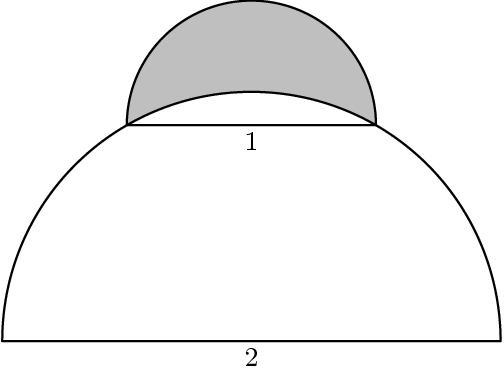
A semicircle of diameter sits at the top of a semicircle of diameter , as shown. The shaded area inside the smaller semicircle and outside the larger semicircle is called a lune. Determine the area of this lune.
- A)
- B)
- C)
- D)
- E)
Answer
C
Key insight
The lune is the small semicircle minus the big circle's segment cut by the small diameter, a chord subtending 60 degrees, so segment = pi/6 - sqrt(3)/4.
Solution
The small semicircle has radius , so its area is .
The lune is what remains of the small semicircle after removing the part that overlaps the big semicircle. That overlap is the region of the big circle (radius ) lying above the chord that serves as the small semicircle's diameter: a circular segment.
Join the big circle's center to the two endpoints of that chord. Then and , so triangle is equilateral and . Therefore
Lune .
The answer is .
Why this works
Regions bounded by arcs of two circles decompose into sectors, triangles and segments. The key auxiliary lines are radii to the chord's endpoints, which reveal the central angle; a chord equal to the radius always gives . Then "segment = sector minus triangle" finishes it.
Alternative approach
Sanity check: the answer must be positive and smaller than . Choice (C) is , plausible; (A) is negative and (D), (E) exceed , so only (B) and (C) survive, and the computation of the segment decides.
The trap
Subtracting the whole 60-degree sector from the small semicircle without adding back the equilateral triangle, or using radius 1 for the small semicircle.
Common mistakes
- Subtracting the whole 60-degree sector from the small semicircle without adding back the equilateral triangle, or using radius 1 for the small semicircle.
- Computing the big circle's area with radius (the diameter) so the sector becomes .
Techniques
Add construction lines/points (drop altitudes, extend segments, connect centers) · Cut the figure into known shapes (triangles, rectangles, sectors)