2019 AMC 10A Problem 16
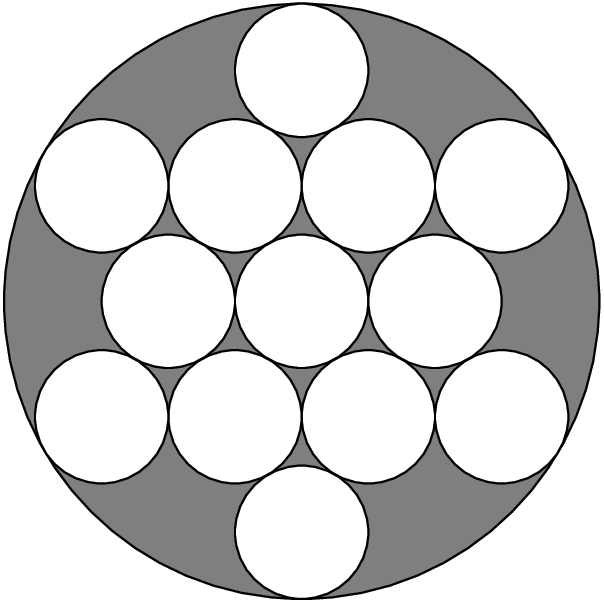
The figure below shows circles of radius within a larger circle. All the intersections occur at points of tangency. What is the area of the region, shaded in the figure, inside the larger circle but outside all the circles of radius
Show solution without answering
Key insight
Join the centers of touching circles; each join is 2 long. The top center is 2 times root 3 above the middle, so the big radius is that plus 1.
Solution
The shaded area is the big circle minus small circles of area each:
where is the big radius. So everything comes down to finding .
1. Touching circles. Two circles of radius that touch have centers exactly apart. So draw segments between the centers of touching circles.
2. Set up coordinates. Put the center of the middle circle at . The middle row has circles at , and .
3. The row just above. Each circle in this row sits in the dip between two circles of the middle row. Its center, with the two centers below it, makes an equilateral triangle of side . The height of that triangle is . So the two inner circles of this row have centers and .
4. The top circle sits in the dip between those two, so by the same reasoning its center is another higher: .
5. The big radius. The top circle touches the big circle, and the big circle is centered at . So is the distance from to plus the top circle's radius:
(The outer circles of the upper row, at , are also from , so they touch the big circle too, matching the picture.)
6. Area.
The answer is .
Why this works
With touching circles, always connect the centers: touching turns into a known distance (the sum of the radii). Circles packed like this make equilateral triangles of side , whose height gives every other distance. Notice how neatly it ends: the in cancels the small circles.
Alternative approach
Work in the triangle , , without coordinates. Both sides from the point have length , and the angle there is (two angles from equilateral triangles). Cut this triangle down the middle into two -- triangles with hypotenuse ; the long leg of each is . So , the same as before.
Concise solution
A shorter write-up, the way contest solutions are usually written. It may take a different route from the solution above.
The shaded area is where is the radius of the large circle, so we only need .
Let be the common center of the large circle and the middle small circle. Tangent unit circles have centers apart. In the picture the circles are arranged in a hexagonal packing: six circles surround the middle one at distance from , and the topmost circle touches two of those (the ones at the upper left and upper right).
Take the top circle's center and the two neighbors' centers and . Then , and sits at above the horizontal, while is straight above . Triangle has with , so it splits into two -- triangles and
The top circle is tangent to the big circle, so .
Shaded area:
The answer is .
Review in the AoPS books
- Introduction to Geometry, Chapter 11: Circles
- Introduction to Geometry, Chapter 4: Perimeter and Area (§4.2)
- Introduction to Geometry, Chapter 19: Problem Solving Strategies in Geometry (§19.1)
- Introduction to Geometry, Chapter 12: Circles and Angles
Similar problems
Problem © Mathematical Association of America (MAA), American Mathematics Competitions. Reproduced for non-commercial educational use. Solution and commentary are original to this site.