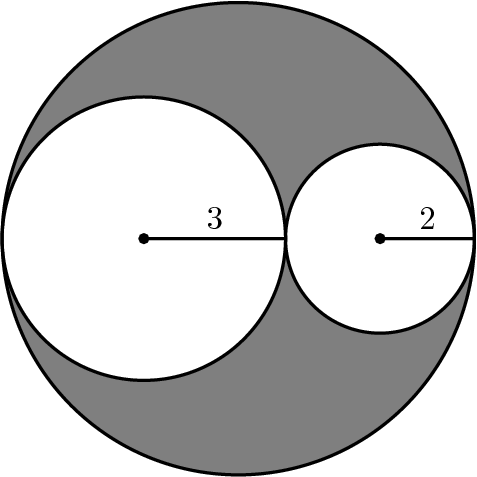
Circles of radius and are externally tangent and are circumscribed by a third circle, as shown in the figure. Find the area of the shaded region.
- A)
- B)
- C)
- D)
- E)
Answer
E
Key insight
The two small circles lie along a diameter of the big circle, so the big diameter is 6 plus 4, giving radius 5.
Solution
Because the small circles are tangent to each other and each is tangent to the big circle, the line through their centers passes through both points where they touch the big circle and through the big circle's center. That line cuts across the big circle along a diameter made of the two small diameters laid end to end:
The shaded region is the big disk with the two small disks removed:
The answer is .
Why this works
Tangent circles have collinear centers, so a chain of tangent circles measures out lengths along a straight line. Here the chain spans the big circle exactly, converting the picture into a single diameter computation. Shaded-region problems are almost always "big area minus the pieces removed."
The trap
Using 10 as the big radius (getting 100 pi) or taking 3 + 2 = 5 as the diameter, instead of recognizing 5 as the radius.
Common mistakes
- Using 10 as the big radius (getting 100 pi) or taking 3 + 2 = 5 as the diameter, instead of recognizing 5 as the radius.
- Subtracting only one of the two small circles, which gives or (not among the choices, a hint that something is off).
Techniques
Cut the figure into known shapes (triangles, rectangles, sectors)