2002 AMC 10A Problem 8
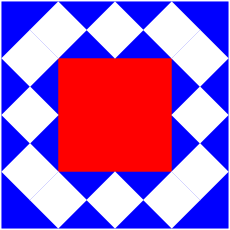
Betsy designed a flag using blue triangles, small white squares, and a red center square, as shown. Let be the total area of the blue triangles, the total area of the white squares, and the area of the red square. Which of the following is correct?
Show solution without answering
Key insight
Cut the flag into 16 equal small squares. The 4 middle ones are red, and each of the 12 border squares is exactly half white and half blue.
Solution
The blue triangles are awkward shapes, so measure the easy pieces (the whole flag, the red square, the white squares) and let subtraction give the blue.
1. Choose a size. Say the flag is by , so its area is . In the picture the red square reaches halfway across the flag, so its side is and
- One white square. Each white square is tilted, standing on a corner. From the picture, its corners touch the flag's edge and the red square, so its height from top corner to bottom corner is , and its width is also . It fits exactly inside a by box and fills half of it (the four corner triangles of the box are outside it). So one white square has area .
3. All white squares. There are along each of the sides, so in all:
4. Blue is everything else:
- So . (The other choices all fail: is not , and is not , and is not .)
The answer is .
Why this works
When some pieces are irregular, measure the regular ones and find the rest by subtracting from the whole. Choosing a convenient size for the flag turns a picture question into arithmetic. A tilted square has half the area of the box it fits in, which is worth remembering.
Alternative approach
Cut the by flag into a grid of by squares. The middle squares make up the red square. Each of the other squares, around the border, contains two halves of white squares and blue everywhere else, so it is exactly half white and half blue. Twelve squares that are each half white and half blue give the same amount of white as blue, so .
Concise solution
A shorter write-up, the way contest solutions are usually written. It may take a different route from the solution above.
Give the flag side length . The red square in the middle has side , so , and the flag's total area is .
The white squares are tilted and each has diagonal (a quarter of the flag's side), so each has area . There are of them (three along each side), giving .
Everything that is neither red nor white is blue:
So , and the answer is .
Review in the AoPS books
- Introduction to Geometry, Chapter 8: Quadrilaterals
- Introduction to Geometry, Chapter 16: The More Things Change. . . (§16.1, §16.2, §16.3, §16.4)
- Introduction to Geometry, Chapter 4: Perimeter and Area (§4.2, §4.3)
- Introduction to Algebra, Chapter 22: Special Manipulations (§22.3)
Similar problems
Problem © Mathematical Association of America (MAA), American Mathematics Competitions. Reproduced for non-commercial educational use. Solution and commentary are original to this site. Also appeared as 2002 12A #8.