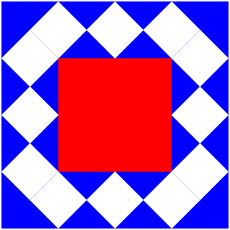
Betsy designed a flag using blue triangles, small white squares, and a red center square, as shown. Let be the total area of the blue triangles, the total area of the white squares, and the area of the red square. Which of the following is correct?
- A)
- B)
- C)
- D)
- E)
Answer
A
Key insight
Cut the flag into a 4-by-4 grid of equal squares; the 12 border squares are each exactly half white and half blue, so B = W.
Solution
Give the flag side length . The red square in the middle has side , so , and the flag's total area is .
The white squares are tilted and each has diagonal (a quarter of the flag's side), so each has area . There are of them (three along each side), giving .
Everything that is neither red nor white is blue:
So , and the answer is .
Why this works
Rather than measuring irregular blue triangles, measure the regular pieces (the whole flag, the red square, the white squares) and let subtraction find the rest. Equivalently, slice the flag into a grid of cells: the four central cells are red, and each of the border cells contains exactly two half-diamonds of white, i.e. half of its area, leaving the other half blue. Looking for a repeating unit cell is the standard move in tiling-style area problems.
The trap
Guessing from the picture that blue covers more than white because the blue pieces are scattered triangles.
Common mistakes
- Guessing from the picture that blue covers more than white because the blue pieces are scattered triangles.
- Computing a white square's area as from its diagonal instead of , which would wrongly give and .
Techniques
Cut the figure into known shapes (triangles, rectangles, sectors) · Exploit symmetry to reduce work or pair up objects