A circle of radius is surrounded by three circles, whose radii are 1, 2, and 3, all externally tangent to the inner circle and externally tangent to each other, as shown in the diagram below.
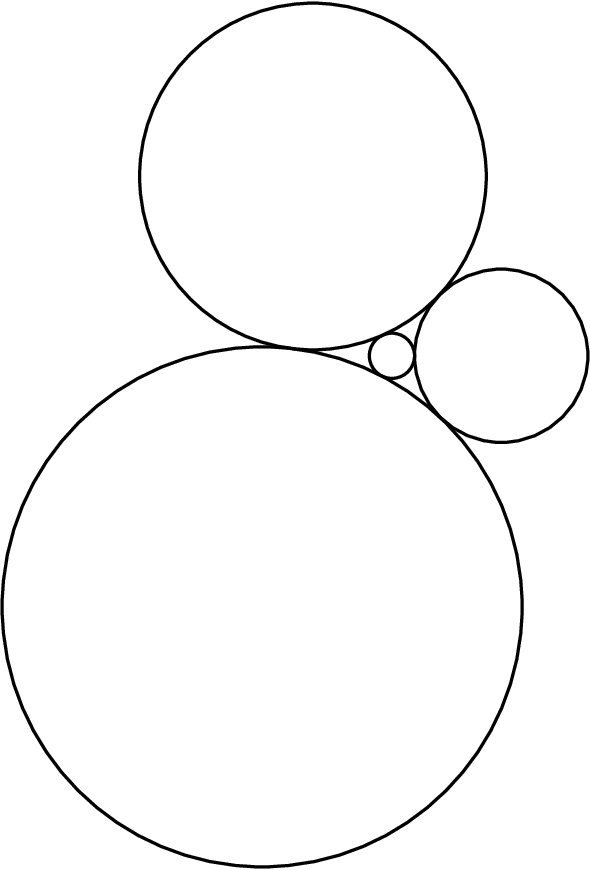
What is ?
- A)
- B)
- C)
- D)
- E)
Answer
B
Key insight
The three outer centres lie 3, 4, 5 apart, so they form a right triangle; subtracting circle equations makes the inner centre's coordinates linear in r.
Solution
Write , , for the centres of the circles of radii and for the centre of the small circle. External tangency means each centre distance is the sum of the two radii:
Since , triangle has a right angle at . That is the gift of the problem: set up coordinates with
and let .
From we have . Subtracting this from kills the quadratic terms:
Subtracting it from in the same way:
Now substitute back into :
Multiplying by and collecting terms,
The discriminant is , so
(the other root is negative). As a check, and , and .
The answer is .
Why this works
Every tangency condition in a chain of mutually tangent circles is a statement about centre distances only, so the picture reduces to a system of distance equations. Two circles centred at known points give equations whose difference is linear — the radical axis — which is why the unknown centre's coordinates come out as linear expressions in rather than requiring a second quadratic. Substituting back leaves exactly one equation in one unknown. The step that makes the computation short is spotting the -- triangle and putting the right angle at the origin; without it the same method still works but the algebra is uglier. The answer choices are all near –, so estimating is useless here and the exact computation must be carried through.
Alternative approach
Descartes' circle theorem states that four mutually tangent circles with curvatures (the reciprocals of the radii, taken positive for external tangency) satisfy
With , , the sum is and , so . The plus sign gives the small circle nestled inside, , hence ; the minus sign, , is the large circle of radius enclosing the whole configuration.
The trap
Assuming the inner circle is the incircle of the triangle of centres, whose inradius is 1, or reading the picture's apparent symmetry as meaning the inner centre is equidistant from the three outer centres.
Common mistakes
- Assuming the inner circle is the incircle of the triangle of centres, whose inradius is 1, or reading the picture's apparent symmetry as meaning the inner centre is equidistant from the three outer centres.
- Using , , , or subtracting radii instead of adding them; all four tangencies here are external, so every centre distance is a sum.
- Taking the wrong root of , or of Descartes' formula, and getting a negative radius or the enclosing circle of radius .
Techniques
Place the figure on coordinates and compute · Set up the equation/formula and compute; no special trick needed