2021 AMC Fall 10B Problem 13
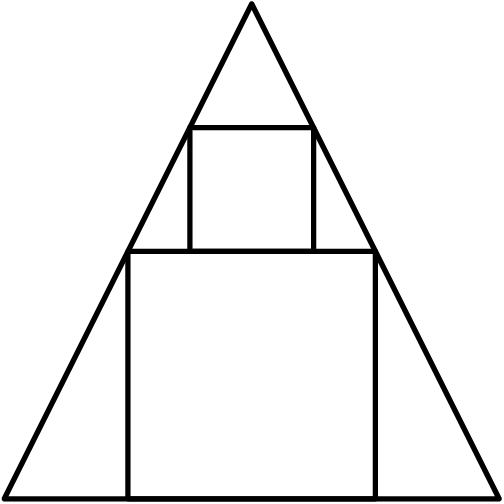
A square with side length is inscribed in an isosceles triangle with one side of the square along the base of the triangle. A square with side length has two vertices on the other square and the other two on sides of the triangle, as shown. What is the area of the triangle?
Show solution without answering
Key insight
The width shrinks steadily going up: 3 wide at height 3, 2 wide at height 5. So the base is 9/2 and the top point is at height 9.
Solution
Measure height from the base of the triangle. The two slanted sides are straight, so the triangle gets narrower at a steady rate as you go up. Two widths are known, and that is enough to find everything.
1. Width at height 3. The big square has side and sits on the base. Its top corners touch the triangle's sides, so at height the triangle is wide.
2. Width at height 5. The small square sits on top of the big one, so its top is at height . Its top corners touch the triangle's sides, so at height the triangle is wide.
3. The rate. Going up units, the width dropped by . So the width drops for every unit up.
4. The base. Going down units from height to the base, the width grows by . So the base is .
5. The top point. Starting from width at height , losing per unit, the width reaches after more units. So the triangle's height is .
6. Area.
| height | 0 | 3 | 5 | 9 |
|---|---|---|---|---|
| width |
The answer is .
Why this works
Cutting a triangle straight across at any height gives a smaller copy of the triangle, so the width changes at a constant rate as you climb. Two measured widths fix that rate and pin down the whole triangle. This is the same as a similar-triangles argument, just packed into one rate calculation.
Alternative approach
Use similar triangles directly. Above height there is a small triangle with base . Above height there is a bigger triangle with base . They are the same shape, so their heights are in the ratio . Their heights also differ by (the small square). Heights and fit both facts. So the top point is at height , and the whole triangle, with height , is times the base- triangle, giving base .
Concise solution
A shorter write-up, the way contest solutions are usually written. It may take a different route from the solution above.
Measure heights from the base. A horizontal slice of the triangle at height has some width ; because the two slanted sides are straight lines, is a linear function of .
The big square's top corners lie on the triangle's sides at height , so . The small square sits on top of the big one, so its top corners are at height and lie on the sides: .
Going up units shrinks the width by , so the width shrinks per unit of height. Therefore
The triangle has base and height , so its area is
The answer is .
Review in the AoPS books
- Introduction to Geometry, Chapter 3: Congruent Triangles
- Introduction to Geometry, Chapter 4: Perimeter and Area (§4.2)
- Introduction to Geometry, Chapter 19: Problem Solving Strategies in Geometry (§19.1)
- Introduction to Geometry, Chapter 5: Similar Triangles
Similar problems
Problem © Mathematical Association of America (MAA), American Mathematics Competitions. Reproduced for non-commercial educational use. Solution and commentary are original to this site.