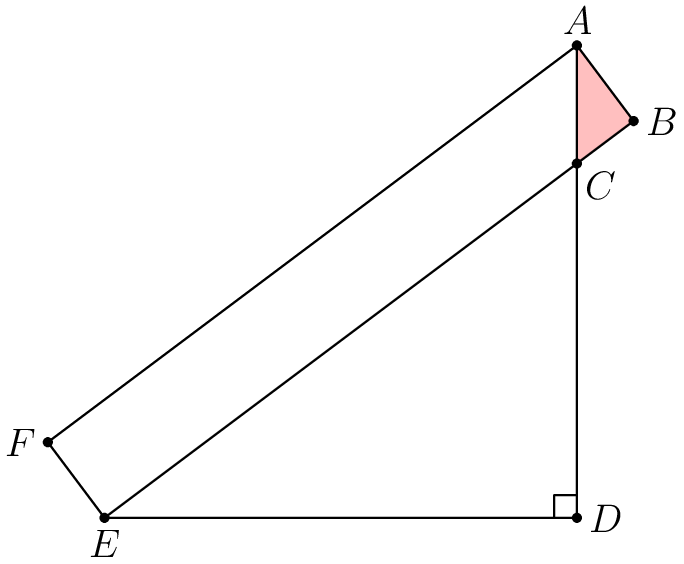
In the figure below, is a rectangle, , , , and . What is the area of ?
- A)
- B)
- C)
- D)
- E)
Answer
A
Key insight
Draw AE: it is the hypotenuse of both right triangles ABE and ADE, so DE = 5 and triangles ABC and EDC are similar in ratio 1 : 5.
Solution
In the figure is the point where crosses , so has the right angle of the rectangle at and
Everything reduces to finding .
Step 1: the diagonal . In rectangle , and , so
Step 2: the length . Since and ,
Step 3: similar triangles. Triangles and have right angles at and at , and because are collinear and are collinear, making these vertical angles. So
Corresponding sides give
Step 4: solve. The point lies on both segments, so and . Substituting,
From the first, ; putting that into the second,
Therefore
The answer is .
Why this works
The data split into two unrelated packets, the rectangle (, ) and the right triangle (, ), and the only segment they share is . Computing two ways is what welds them together and reveals the hidden fact . After that, two lines crossing at create a pair of similar triangles whose ratio is known, and the two "the pieces add to the whole" equations turn the geometry into a linear system. The pattern, similar triangles at a crossing plus segment-sum equations, is worth keeping: it avoids the quadratic that appears if one instead writes .
Alternative approach
Coordinates. Put , , and, using from Step 2, . The point satisfies and ; subtracting the two circle equations gives the line , and solving yields , the root on the far side of from . Line meets at , so and the distance from to line is . Hence .
The trap
Reading the ratio 1 : 5 as a division of BE and concluding BC = 7/6; the similarity pairs BC with DC and AC with EC, never BC with CE.
Common mistakes
- Reading the ratio 1 : 5 as a division of BE and concluding BC = 7/6; the similarity pairs BC with DC and AC with EC, never BC with CE.
- Assuming is the midpoint of or of , which the figure suggests only because it is not to scale.
- Taking and as the sides of the rectangle; the rectangle's sides are and , and is not a side at all.
Techniques
Add construction lines/points (drop altitudes, extend segments, connect centers) · Set up the equation/formula and compute; no special trick needed