2024 AMC 10B Problem 25
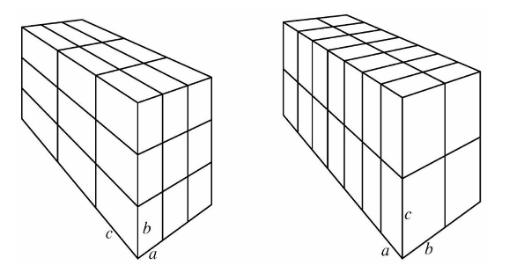
Each of bricks (right rectangular prisms) has dimensions , where , , and are pairwise relatively prime positive integers. These bricks are arranged to form a block, as shown on the left below. A th brick with the same dimensions is introduced, and these bricks are reconfigured into a block, shown on the right. The new block is unit taller, unit wider, and unit deeper than the old one. What is ?
Show solution without answering
Key insight
A new side cannot grow from the same brick edge as before. That forces 7a = 3c + 1, 2b = 3a + 1, 2c = 3b + 1.
Solution
Step 1: write the sizes.
- The old block is bricks in each direction, so its sides are , , .
- In the new block every brick points the same way. Say the direction with bricks runs along the brick edge , and the two directions with bricks run along and . Then the new sides are , , .
- Each new side is more than one of the old sides, and each old side is used once.
Step 2: match new sides to old sides.
- A new side cannot match the old side made from the same brick edge. For example would give , and would give . Neither is a positive whole number.
- So must match or . The names and are interchangeable so far, so say .
- Now must match or . It cannot be (step 4), so .
- That leaves .
Step 3: solve.
8. The three equations are
9. From the second, . Put that in the third: , so .
10. Put this in the first: . Multiply by : , so .
11. Then and . Check the first equation: . Also , , share no common factor in any pair, as the problem requires.
12. So .
The answer is .
Why this works
The real puzzle is deciding which new side grows from which old side. One quick impossibility check (a side cannot grow from its own brick edge) leaves only one way to match them, and after that it is three simple equations. Picture the blocks by their structure (how many bricks run in each direction) rather than assuming the bricks keep their old positions.
Alternative approach
Add the three equations: . This simplifies to , so . That is more than a multiple of (since ). Among the choices, only is more than a multiple of .
Concise solution
A shorter write-up, the way contest solutions are usually written. It may take a different route from the solution above.
The old block has dimensions . In the new block the bricks are all oriented the same way, so its dimensions are where is some ordering of . Each new dimension is exactly more than one old dimension, matching them up one to one.
A new dimension cannot be matched with the old dimension built from the same edge: and have no positive solutions. So the matching is a derangement of three items, which must be a -cycle. Naming the edges so that the -direction uses , the equations are
(the other -cycle is the same system with and swapped).
Substitute upward: , then , then
Then and . These are pairwise coprime, as required, and
The answer is .
Review in the AoPS books
- Introduction to Algebra, Chapter 5: Multi-Variable Linear Equations (§5.2, §5.3, §5.6)
- Introduction to Number Theory, Chapter 7: Algebra With Integers
- Introduction to Geometry, Chapter 14: Three-Dimensional Geometry
- Intermediate Algebra, Chapter 1: Basic Techniques for Solving Equations (§1.4)
Similar problems
Problem © Mathematical Association of America (MAA), American Mathematics Competitions. Reproduced for non-commercial educational use. Solution and commentary are original to this site.