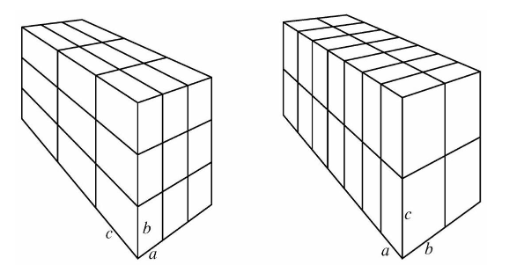
Each of bricks (right rectangular prisms) has dimensions , where , , and are pairwise relatively prime positive integers. These bricks are arranged to form a block, as shown on the left below. A th brick with the same dimensions is introduced, and these bricks are reconfigured into a block, shown on the right. The new block is unit taller, unit wider, and unit deeper than the old one. What is ?
- A)
- B)
- C)
- D)
- E)
Answer
E
Key insight
2p or 7p never equals 3p+1, so each new dimension comes from a different edge: 7p = 3q+1, 2q = 3r+1, 2r = 3p+1.
Solution
The old block has dimensions . In the new block the bricks are all oriented the same way, so its dimensions are where is some ordering of . Each new dimension is exactly more than one old dimension, matching them up one to one.
A new dimension cannot be matched with the old dimension built from the same edge: and have no positive solutions. So the matching is a derangement of three items, which must be a -cycle. Naming the edges so that the -direction uses , the equations are
(the other -cycle is the same system with and swapped).
Substitute upward: , then , then
Then and . These are pairwise coprime, as required, and
The answer is .
Why this works
The physical setup hides a linear system, but the real insight is deciding which new dimension corresponds to which old one. Ruling out "same edge" pairings by a one-line impossibility argument leaves a single cyclic structure, and the sum is the same regardless of how the letters are attached. Read figures for structure ( bricks along one direction), not for orientation promises.
Alternative approach
Add the three equations: , so and . Among the choices only leaves remainder when divided by .
The trap
Assuming the bricks keep their orientation, so that the new width 2a should be 3a + 1, which is impossible and stalls the whole problem.
Common mistakes
- Assuming the bricks keep their orientation, so that the new width 2a should be 3a + 1, which is impossible and stalls the whole problem.
- Solving the system with a fraction error (e.g. handled as ) and landing on a non-integer, then guessing.
Techniques
Use the answer choices (mod checks, size, form) to eliminate or select · Set up the equation/formula and compute; no special trick needed