2001 AMC 10 Problem 22
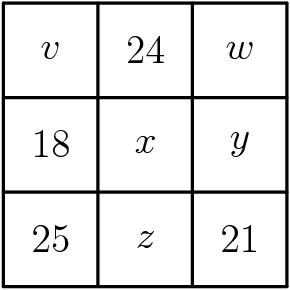
In the magic square shown, the sums of the numbers in each row, column, and diagonal are the same. Five of these numbers are represented by , , , , and . Find .
Show solution without answering
Key insight
Compare two lines that share an unknown number; that unknown cancels. The left column against the top row gives w = 19, and against the diagonal gives x = 22.
Solution
1. Read the square from the picture:
Every row, column and diagonal has the same total.
2. The left column has only one unknown, : its total is . Compare it with other lines through , so the cancels.
3. Top row against left column. Top row: . Left column: . The totals are equal, so and .
4. Diagonal against left column. The diagonal from top left to bottom right is . Setting it equal to gives , so .
5. Find the common total. The other diagonal is . So every line adds to .
6. Bottom row: , so .
7. Middle row: , so .
8. Check with a column: the right column is . It works.
9. So .
The answer is .
Why this works
A magic square gives many more equations than you need. The quick way is to set two lines equal when they share an unknown: that unknown appears on both sides and cancels, leaving a number. Two such comparisons plus one line to find the common total are enough here.
Alternative approach
In every magic square, the center number is one third of the common total. Once step 4 gives , the total is . Then the middle row gives , and the middle column gives , so .
Concise solution
A shorter write-up, the way contest solutions are usually written. It may take a different route from the solution above.
The square, row by row, is
Let be the common sum.
The left column and the main diagonal both contain : , so .
The top row and the left column both contain : , so . Now the other diagonal gives .
Bottom row: , so . Middle row: , so . (Then , and every line checks.)
Hence .
The answer is .
Review in the AoPS books
- Introduction to Algebra, Chapter 5: Multi-Variable Linear Equations (§5.2, §5.3, §5.6)
- Intermediate Algebra, Chapter 1: Basic Techniques for Solving Equations (§1.4)
Similar problems
Problem © Mathematical Association of America (MAA), American Mathematics Competitions. Reproduced for non-commercial educational use. Solution and commentary are original to this site.