2024 AMC 10B Problem 21
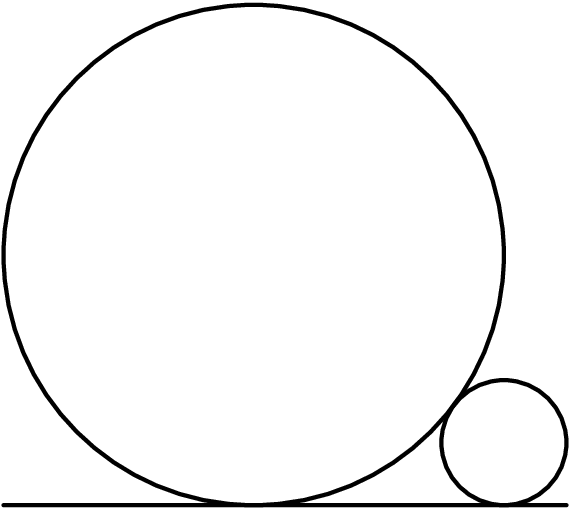
Two straight pipes (circular cylinders), with radii and , lie parallel and in contact on a flat floor. The figure below shows a head-on view. What is the sum of the possible radii of a third parallel pipe lying on the same floor and in contact with both?
Show solution without answering
Key insight
Two touching circles of radii r and s sit 2 times root(rs) apart along the floor. Measure along the floor for each spot the third pipe could take.
Solution
Look at the pipes head-on: they are circles sitting on a line (the floor). The trick is to measure everything along the floor.
A useful rule: where two touching circles meet the floor.
1. Take circles of radius and on the floor, touching each other. Their centers are at heights and , and the distance between the centers is .
2. Draw a right triangle: the slanted side joins the centers (length ), the vertical side is the difference in heights (), and the horizontal side is the distance between the two floor points.
3. By the Pythagorean theorem:
Use the rule.
4. For the given pipes ( and ): the floor points are apart.
5. Let the third pipe have radius . Its floor point is from the big pipe's floor point and from the small pipe's.
6. The third pipe can sit in three places. Check each:
- Between the two pipes. The two distances add to : , so and .
- Beyond the small pipe. The distance to the big pipe is more than the distance to the small pipe: , so and .
- Beyond the big pipe. Then , which would make negative. Impossible.
7. The possible radii are and . Their sum is .
The answer is .
Why this works
Circles that sit on the same line and touch each other follow one simple rule: their floor points are apart. That turns a circle problem into adding and subtracting distances along one line. The question asks for a sum of radii, which is a hint that more than one position works, so check every place the third pipe could go.
Concise solution
A shorter write-up, the way contest solutions are usually written. It may take a different route from the solution above.
A lemma. Let two circles of radii and rest on the floor and touch each other. Their centers are at heights and , and the distance between centers is . Drop a perpendicular from the higher center to the horizontal line through the lower one: the horizontal leg (the distance between the two floor contact points) satisfies
For the given pipes, the contact points are apart.
The third pipe, radius , has a contact point at horizontal distance from the big pipe's and from the small pipe's. Its contact point is either between the other two or outside them.
- Between: , so and .
- Beyond the small pipe: , so and .
- Beyond the big pipe: has no positive solution.
The possible radii are and , with sum .
The answer is .
Review in the AoPS books
- Introduction to Geometry, Chapter 11: Circles
- Introduction to Geometry, Chapter 4: Perimeter and Area (§4.2)
- Introduction to Geometry, Chapter 19: Problem Solving Strategies in Geometry (§19.1)
- Introduction to Counting & Probability, Chapter 2: Basic Counting Techniques (§2.2)
Similar problems
Problem © Mathematical Association of America (MAA), American Mathematics Competitions. Reproduced for non-commercial educational use. Solution and commentary are original to this site.