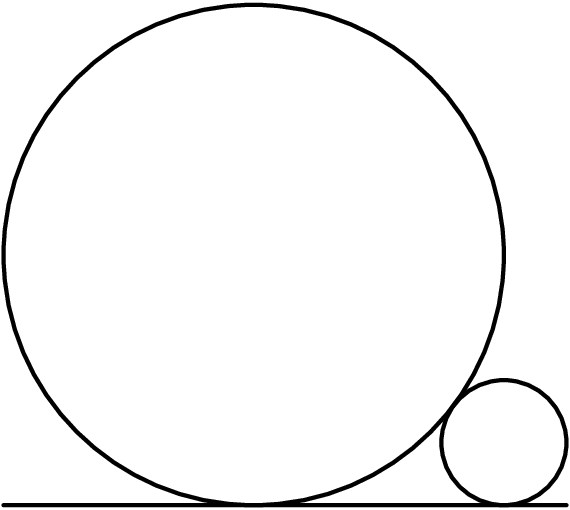
Two straight pipes (circular cylinders), with radii and , lie parallel and in contact on a flat floor. The figure below shows a head-on view. What is the sum of the possible radii of a third parallel pipe lying on the same floor and in contact with both?
- A)
- B)
- C)
- D)
- E)
Answer
C
Key insight
Circles of radii r, s tangent to each other and the floor touch it 2sqrt(rs) apart; the third pipe fits between (1/9) or beyond (1).
Solution
A lemma. Let two circles of radii and rest on the floor and touch each other. Their centers are at heights and , and the distance between centers is . Drop a perpendicular from the higher center to the horizontal line through the lower one: the horizontal leg (the distance between the two floor contact points) satisfies
For the given pipes, the contact points are apart.
The third pipe, radius , has a contact point at horizontal distance from the big pipe's and from the small pipe's. Its contact point is either between the other two or outside them.
- Between: , so and .
- Beyond the small pipe: , so and .
- Beyond the big pipe: has no positive solution.
The possible radii are and , with sum .
The answer is .
Why this works
Circles resting on a common line and touching each other are governed by one clean relation: contact points apart. That converts a tangency problem into additions and subtractions of square roots of radii along the floor, so the whole configuration lives on one number line. The question asks for a sum, a hint that more than one pipe works; check every side.
Alternative approach
Descartes' circle theorem with the floor as a circle of curvature : curvatures satisfy , i.e. , so or and the radii are and .
The trap
Finding only the small pipe wedged between the two and answering 1/9, forgetting that a pipe on the far side of the small one is also in contact with both.
Common mistakes
- Finding only the small pipe wedged between the two and answering 1/9, forgetting that a pipe on the far side of the small one is also in contact with both.
- Setting the center-to-center distance equal to the horizontal gap (ignoring the vertical offset ), which breaks the relation.
Techniques
Add construction lines/points (drop altitudes, extend segments, connect centers) · Split into exhaustive cases and handle each