2023 AMC 10A Problem 24
Six regular hexagonal blocks of side length unit are arranged inside a regular hexagonal frame. Each block lies along an inside edge of the frame and is aligned with two other blocks, as shown in the figure below. The distance from any corner of the frame to the nearest vertex of a block is unit. What is the area of the region inside the frame not occupied by the blocks? 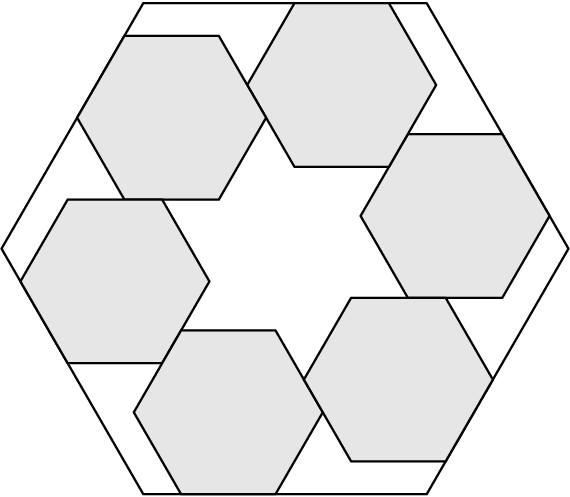
Show solution without answering
Key insight
Only the frame's side matters. Neighboring blocks share a side line, which forces the two gaps on each frame edge to add up to 2, so the side is 3.
Solution
Plan. The six blocks always cover the same area, so we only need the side length of the frame. Then
A regular hexagon with side is made of equilateral triangles, so its area is .
Step 1: What one frame edge looks like. Look at the figure. Each frame edge has one block lying along it. Between the block and one end of the edge there is a short gap, and between the block and the other end there is a long gap. The problem says the short gap is . Call the long gap . Then
At every corner of the frame, one block is away and the neighboring block is away.
Step 2: Use the fact that neighbors touch. Pick a corner of the frame. Call the block that is from and the block that is from (on the other edge at ). In the figure, and touch along a shared side. Call the straight line through that shared side .
1. Extend past until it hits the frame edge that sits on, at a point . The corner of nearest , the next corner of , and form a small triangle with two angles (each hexagon angle is , so the angle next to it on a straight line is ). So it is an equilateral triangle with side , and is unit closer to than is. That gives
2. Now extend past the other way, and extend 's frame edge past beyond the corner. They meet at a point outside the frame. The corner of nearest , the next corner of (the one where 's side on begins), and again form an equilateral triangle with side . So is unit from 's corner, which is from . That makes
3. Now look at triangle . Its angle at is (the frame corner is ), and its angle at is (from the equilateral triangle in step 2). So triangle is equilateral too, and
4. Put steps 1 and 3 together: , so .
Step 3: The frame side.
Step 4: The area.
The answer is .
Why this works
Every angle in this picture is or , so extending sides keeps producing equilateral triangles, and those turn angle facts into length facts. The real rule that fixes the frame is "neighboring blocks share a side line." In fact the two gaps always add up to , so the frame side is no matter what the short gap is. On hard problems, check which given numbers really matter.
Alternative approach
Use coordinates. Put at the origin with one frame edge along the positive -axis and the other pointing up-left at . Let block sit on the -axis at distance from and block on the other edge at distance from . Working out the corners of the two hexagons, 's upper-left side lies on the line and 's matching side lies on . The two blocks share this line, so , which means and the frame side is .
Concise solution
A shorter write-up, the way contest solutions are usually written. It may take a different route from the solution above.
Only the frame's side length is needed: the answer is .
By rotational symmetry every frame edge looks the same: its block sits at distance from one endpoint and from the other, so , and at each corner one adjacent block is away and the other is away. The given is the smaller of .
Place a corner at the origin with one frame edge along the positive -axis and the other along direction . The block on the -axis has base from to ; its upper-left side runs from to , on the line .
The other block's nearest vertex is . From its next side runs unit parallel to the -axis to , and the following side climbs at , along the line .
"Aligned" means these two slanted sides lie on a common line (the blocks touch along it), so , i.e. . Hence regardless of the value .
The empty area is
The answer is .
Review in the AoPS books
- Introduction to Geometry, Chapter 8: Quadrilaterals
- Introduction to Geometry, Chapter 2: Angles
- Introduction to Geometry, Chapter 17: Analytic Geometry
- Introduction to Geometry, Chapter 4: Perimeter and Area (§4.2, §4.3)
Similar problems
Problem © Mathematical Association of America (MAA), American Mathematics Competitions. Reproduced for non-commercial educational use. Solution and commentary are original to this site.