Six regular hexagonal blocks of side length unit are arranged inside a regular hexagonal frame. Each block lies along an inside edge of the frame and is aligned with two other blocks, as shown in the figure below. The distance from any corner of the frame to the nearest vertex of a block is unit. What is the area of the region inside the frame not occupied by the blocks? 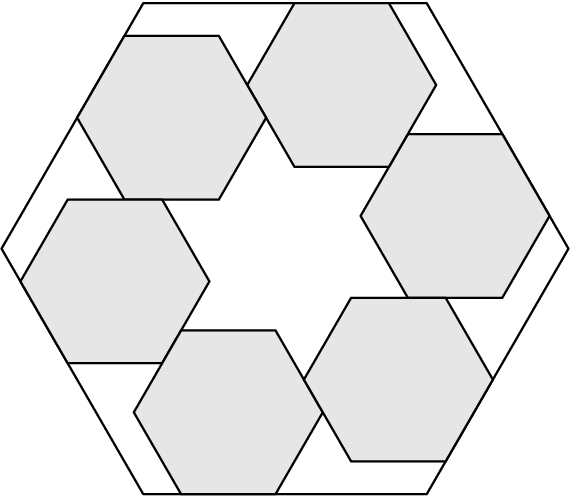
- A)
- B)
- C)
- D)
- E)
Answer
C
Key insight
The 3/7 gap and the gap on the other side of a block sum to 2 because neighboring blocks share a side line, so the frame has side 3.
Solution
Only the frame's side length is needed: the answer is .
By rotational symmetry every frame edge looks the same: its block sits at distance from one endpoint and from the other, so , and at each corner one adjacent block is away and the other is away. The given is the smaller of .
Place a corner at the origin with one frame edge along the positive -axis and the other along direction . The block on the -axis has base from to ; its upper-left side runs from to , on the line .
The other block's nearest vertex is . From its next side runs unit parallel to the -axis to , and the following side climbs at , along the line .
"Aligned" means these two slanted sides lie on a common line (the blocks touch along it), so , i.e. . Hence regardless of the value .
The empty area is
The answer is .
Why this works
The blocks' area is fixed, so everything hinges on the frame's side, and the true constraint is the alignment of neighboring blocks, not the . Translating "sides are collinear" into equal line equations at a single corner uses the corner and the hexagon's slopes. Checking which given numbers actually matter is a valuable habit on hard problems.
Alternative approach
With and known, verify: the two aligned sides overlap along the common line for a length of , matching the picture where neighboring blocks touch. Numerically, ; the decoys and come from misusing .
The trap
Building the frame side from 3/7 alone (e.g. 1 + 6/7 or similar), which produces the decoy answers with 49 in the denominator.
Common mistakes
- Building the frame side from 3/7 alone (e.g. 1 + 6/7 or similar), which produces the decoy answers with 49 in the denominator.
- Using area (a triangle) or for a regular hexagon instead of .
Techniques
Place the figure on coordinates and compute · Cut the figure into known shapes (triangles, rectangles, sectors)