2021 AMC Fall 10B Problem 25
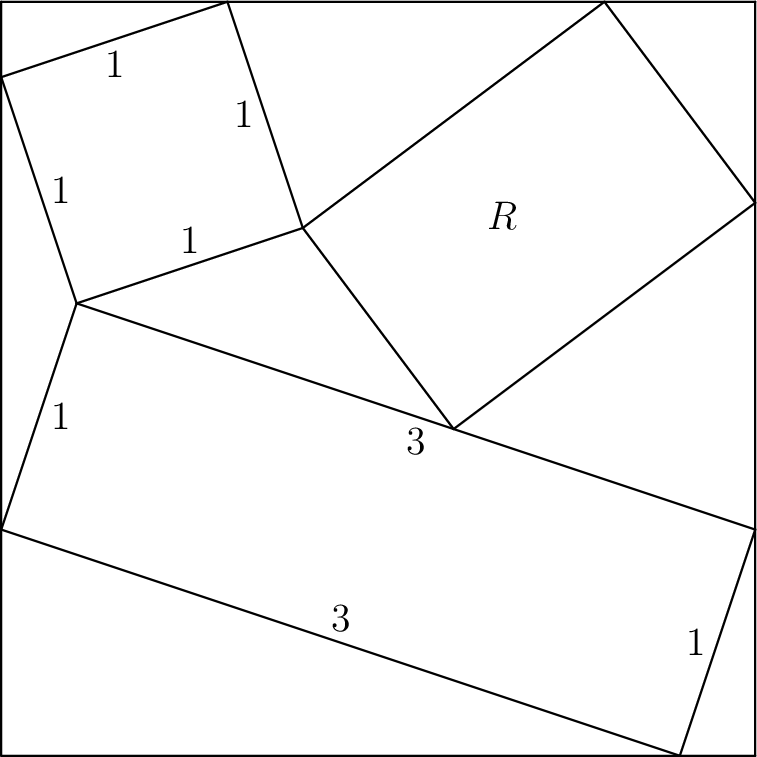
A rectangle with side lengths and a square with side length and a rectangle are inscribed inside a larger square as shown. The sum of all possible values for the area of can be written in the form , where and are relatively prime positive integers. What is
Show solution without answering
Key insight
The 1 by 3 rectangle and unit square fix the big square. In units where it is 10 by 10, rectangle R gives a quadratic with two answers.
Solution
Step 1: pin down the tilt. The rectangle is tilted. Say its short side (length ) goes across and up, so . The long side is at a right angle to it, so it goes across and up.
- Width of the big square. The rectangle touches the left, bottom and right sides. Across the bottom it spans one long side plus one short side: width .
- Height of the big square. Go up the left side: the long side rises to reach the left wall, then the short side rises to the rectangle's top corner. The unit square sits on that corner: its side to the left wall has length and runs across (from the corner back to the wall), so, just like the rectangle's short side, it rises ; and its next side rises to reach the top. Height .
- Square, so width = height. , which gives . Then , so and . The big square's side is .
Step 2: nicer units. Measure lengths in units of . Then , , and the big square is with corner . Areas in these units are times too big, so divide by at the end. The pieces now have whole-number corners:
- rectangle: , , , . Its top side runs from to along the line .
- Unit square: , , , . Rectangle has its corner at .
Step 3: rectangle . has corner , one corner on the top side , one on the right side , and one corner on the line .
1. Going from to climbs (from to ). Call the sideways distance , so is " across, up."
2. Side is at a right angle to , so it goes in the direction " across, down." Say is times that: .
3. Fourth corner on the right side. The fourth corner is moved the same way as , so its -coordinate is . So .
4. on the line. , which simplifies to .
5. Solve. Put into step 4: , so , which factors as .
- , : is , length , and is , length . Area .
- , : is , length , and is , length . Area .
6. Both fit. For the corners are . For they are . In both, lands on the rectangle's top side between and .
Step 4: real areas. Divide by : and . The sum is
so .
The answer is .
Why this works
Two of the three pieces are rigid enough to fix the big square completely, while has some freedom, which is why the problem says "all possible values." Three touching conditions on give equations with a quadratic at the end, so two rectangles work. Choosing units that put every known corner at whole-number coordinates keeps the algebra small.
Concise solution
A shorter write-up, the way contest solutions are usually written. It may take a different route from the solution above.
Step 1: the fixed pieces. Let the rectangle's long side make angle with the horizontal, its corners on the left, bottom and right sides of the big square. Its horizontal span is the big side, ; its top corner has height and is from the left side.
The unit square has a vertex at , one on the left side and one on the top. Its side from to the left side has run , hence rise ; the next side rises more to reach the top, so . Equating: and .
Step 2: coordinates. Scale by so the big square is . The rectangle's top side is the segment of from to , and the unit square's free vertex is .
Step 3: rectangle . has vertex , vertex on , a vertex on , and vertex on . Let its sides from be toward and toward . The conditions are , , and . With they combine to
so or .
For : , , area . For : , area . Both fit in the square. Areas scale by , so the true areas sum to , giving .
The answer is .
Review in the AoPS books
- Introduction to Geometry, Chapter 8: Quadrilaterals
- Introduction to Geometry, Chapter 3: Congruent Triangles
- Introduction to Algebra, Chapter 10: Quadratic Equations – Part 1 (§10.2, §10.3, §10.4)
- Introduction to Geometry, Chapter 17: Analytic Geometry (§17.4, §17.6)
Similar problems
Problem © Mathematical Association of America (MAA), American Mathematics Competitions. Reproduced for non-commercial educational use. Solution and commentary are original to this site.