2021 AMC Fall 10B Problem 15
In square , points and lie on and , respectively. Segments and intersect at right angles at , with and . What is the area of the square?
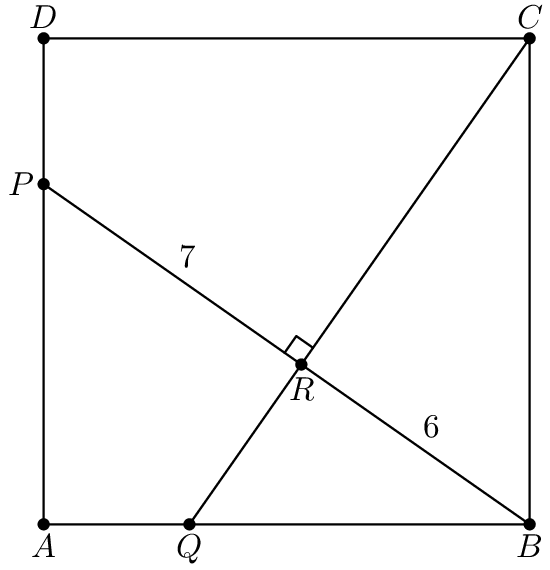
Show solution without answering
Key insight
Turning the square a quarter turn moves BP exactly onto CQ, so CQ = 13. Then BR is the height to the long side of right triangle QBC.
Solution
1. Show . Label the square top-left, bottom-left, bottom-right, top-right, so is on the top side and is on the left side . Look at triangles and .
- Both have a right angle (at and at ).
- (sides of the square).
- Because and cross at a right angle, angle equals angle . (In triangle , angle + angle ; also angle + angle .)
So the triangles are congruent, and .
2. Focus on triangle . It has a right angle at , and its long side is . The segment drops from the right angle and meets at a right angle, so is the height to the long side.
3. Use the right-triangle height facts. The height splits the long side into and . The two small triangles and have the same shape as each other, which gives
Also . Two numbers that add to and multiply to : they are and .
4. Find the side. Triangle has the same shape as triangle , so , which gives .
- If : .
- If : .
5. Which one is real? In the same way, . If , then and , which is bigger than the side squared, . Then would be past the end of side , which is not allowed. So and the area is .
The answer is .
Why this works
Two segments inside a square that cross at a right angle and each run between sides like this are always the same length: a quarter turn of the square carries one onto the other. That turns the odd-looking lengths and into the long side of a right triangle with a known height. The "height to the long side" facts, height squared equals the product of the two pieces and a leg squared equals its piece times the whole, then finish the job.
Alternative approach
Call the side . From step 1, triangle (right angle at ) has the same shape as triangle (right angle at ). Matching sides: and . So and . Pythagoras in triangle : . Trying the choices, gives . It works, and is choice (D). (The equation has one other solution, , but it is not a choice, and step 5 shows it would put off the side.)
Concise solution
A shorter write-up, the way contest solutions are usually written. It may take a different route from the solution above.
Rotate the square about its center so that , , . Side goes to side , and segment goes to a segment from to a point of , rotated from . Since is also perpendicular to and passes through , that image is exactly . Hence .
Now look at right triangle (right angle at ). Its hypotenuse is , and means is the foot of the altitude from . The altitude-to-hypotenuse relations give
So , and is either or .
If , then , so would lie outside side . Hence and the area is .
The answer is .
Review in the AoPS books
- Introduction to Geometry, Chapter 3: Congruent Triangles
- Introduction to Geometry, Chapter 4: Perimeter and Area (§4.2)
- Introduction to Algebra, Chapter 22: Special Manipulations (§22.3)
- Introduction to Geometry, Chapter 5: Similar Triangles
Similar problems
Problem © Mathematical Association of America (MAA), American Mathematics Competitions. Reproduced for non-commercial educational use. Solution and commentary are original to this site.