In square , points and lie on and , respectively. Segments and intersect at right angles at , with and . What is the area of the square?
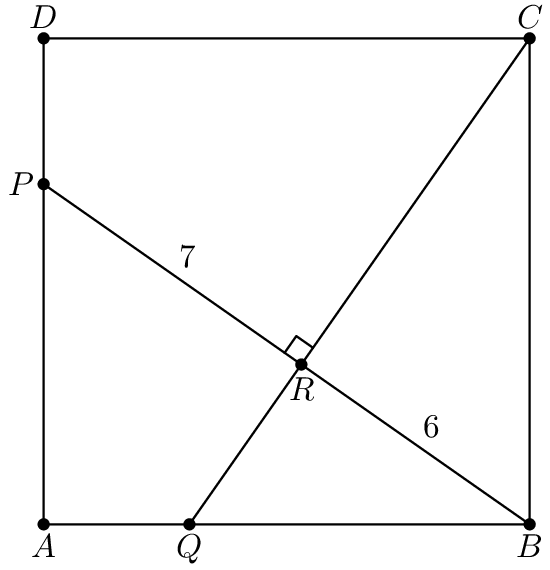
- A)
- B)
- C)
- D)
- E)
Answer
D
Key insight
A quarter turn of the square carries BP onto CQ, so CQ = 13; then BR is the altitude to the hypotenuse of right triangle QBC.
Solution
Rotate the square about its center so that , , . Side goes to side , and segment goes to a segment from to a point of , rotated from . Since is also perpendicular to and passes through , that image is exactly . Hence .
Now look at right triangle (right angle at ). Its hypotenuse is , and means is the foot of the altitude from . The altitude-to-hypotenuse relations give
So , and is either or .
If , then , so would lie outside side . Hence and the area is .
The answer is .
Why this works
Two perpendicular segments joining sides of a square are images of each other under a quarter turn, so they are equal in length; this converts the strange piece of data ( and ) into the hypotenuse of a right triangle whose altitude is known. The mean-proportional relations and then finish without any variable.
Alternative approach
Let the side be and . In right triangle , (from the congruent triangles), so ; from triangle , . Then gives , so or ; only is a choice.
The trap
Trying to solve with the side as unknown in two similar triangles and getting a quartic, or picking the root 52 without checking that Q must lie on side AB.
Common mistakes
- Trying to solve with the side as unknown in two similar triangles and getting a quartic, or picking the root 52 without checking that Q must lie on side AB.
- Assuming is half of or that is the center of the square; nothing in the problem forces that.
Techniques
Set up the equation/formula and compute; no special trick needed · Exploit symmetry to reduce work or pair up objects