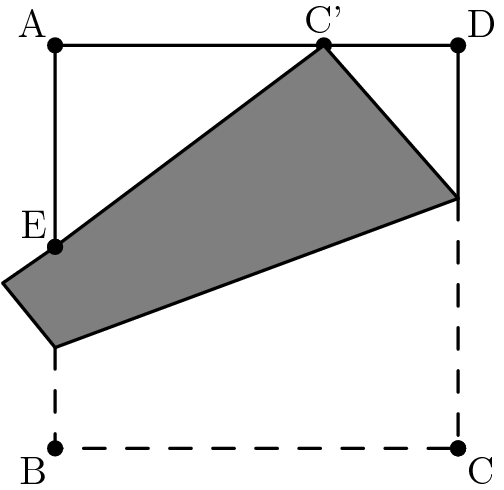
A square piece of paper has side length and vertices and in that order. As shown in the figure, the paper is folded so that vertex meets edge at point , and edge at point . Suppose that . What is the perimeter of triangle
- A)
- B)
- C)
- D)
- E)
Answer
A
Key insight
Fold preserves lengths, so the small right triangle at D has perimeter DC' + DC = 4/3; triangle AEC' is similar to it with ratio AC'/DF = 3/2.
Solution
Let be the point where the crease meets side . Folding is a reflection across the crease, so and the right angle at is carried to : .
Triangle . Let , so . Right triangle gives
so . Its perimeter is (equivalently , since ).
Similarity. At the angles , , and lie along line , so . In right triangle , as well, hence . With right angles at and , triangles and are similar, and the ratio is
Perimeters scale by the same ratio: perimeter of is .
The answer is .
Why this works
Folding problems are reflection problems: matched segments are equal () and the folded corner keeps its right angle. A right angle placed on a straight edge produces two similar right triangles on either side; the small one at is fully determined by one Pythagorean equation, and similarity transfers its perimeter. In fact the perimeter of the cut-off triangle is always , half the square's perimeter, wherever lands on ; choice (A) being the only "clean" constant is a hint.
Alternative approach
Coordinates with , , , , . The crease is the perpendicular bisector of : through with slope . Reflecting across it gives ; line has slope and meets at . Then , , , total .
The trap
Assuming AE = EC' or that the crease passes through E; E lies on the folded image of edge CB, not on the crease.
Common mistakes
- Assuming AE = EC' or that the crease passes through E; E lies on the folded image of edge CB, not on the crease.
- Writing but then setting or forgetting that , which breaks the Pythagorean equation.
Techniques
Set up the equation/formula and compute; no special trick needed · Exploit symmetry to reduce work or pair up objects