2002 AMC 10A Problem 25
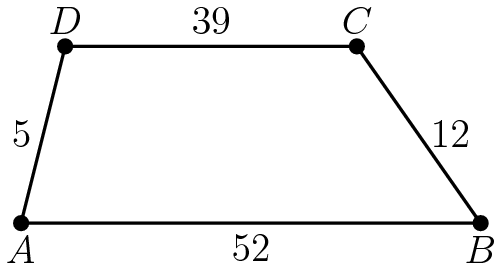
In trapezoid with bases and , we have , , , and . The area of is
Show solution without answering
Key insight
Slide leg DA over to start at C. It cuts off a 5-12-13 right triangle (13 = 52 - 39), and that triangle's height is the trapezoid's height.
Solution
For the area we need the height, which is not given. The trick is to move one slanted side so that both slanted sides end up in one triangle.
1. Cut off a triangle. From , draw a segment parallel to , meeting at . Now has both pairs of opposite sides parallel, so it is a parallelogram, and
2. The leftover triangle has sides
These are , , : since , it is a right triangle with the right angle at .
- Its area. The legs and are a base and a height: area .
4. The height of the trapezoid. The side lies along , and the height from down to is the trapezoid's height . Using as the base, the same area is . So
5. Area of the trapezoid. Average the two bases and multiply by the height:
(Check another way: the parallelogram has area , and adding the triangle's gives .)
The answer is .
Why this works
A trapezoid is a parallelogram plus a triangle. Sliding one leg across puts both legs into one triangle whose third side is the difference of the bases. Here that triangle is the -- right triangle, and computing its area two ways gives the height. When legs and the difference of the bases form a familiar right triangle, expect this trick.
Alternative approach
Extend the two legs until they meet at a point above . Triangle is a smaller copy of triangle , with sides as long. Since is the missing quarter of , and ; in the same way and . Triangle has sides , , , which is -- times , so it has a right angle at . Then
Concise solution
A shorter write-up, the way contest solutions are usually written. It may take a different route from the solution above.
Through draw the segment parallel to , meeting at . Then is a parallelogram, so and . The leftover piece is triangle with
Since , this triangle is right-angled at , and its area is .
The height of the trapezoid equals the altitude of this triangle onto its hypotenuse (which lies along ):
Now apply the trapezoid area formula:
The answer is .
Review in the AoPS books
- Introduction to Geometry, Chapter 8: Quadrilaterals
- Introduction to Geometry, Chapter 4: Perimeter and Area (§4.2)
- Introduction to Geometry, Chapter 19: Problem Solving Strategies in Geometry (§19.1)
- Introduction to Geometry, Chapter 9: Polygons (§9.3)
Similar problems
Problem © Mathematical Association of America (MAA), American Mathematics Competitions. Reproduced for non-commercial educational use. Solution and commentary are original to this site.