In square , points and lie on and , respectively, so that Points and lie on and , respectively, and points and lie on so that and . See the figure below. Triangle , quadrilateral , quadrilateral , and pentagon each has area What is ? 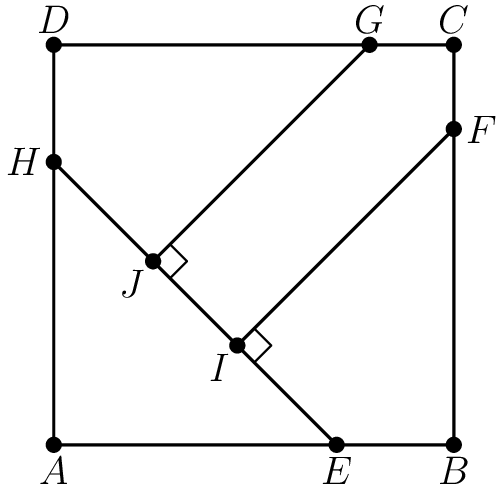
- A)
- B)
- C)
- D)
- E)
Answer
B
Key insight
Extend CB, CD to line EH: the pentagon is a right isosceles triangle of altitude 2 sqrt(2) - 1 minus two 45-degree corners of leg FI.
Solution
The four regions tile the square, so its area is and its side is . Triangle is right isosceles with area , so and ; its altitude from to has length . Since , the distance from to line is
Extend and until they meet line at and . Triangle has a right angle at and is symmetric about , so it is right isosceles with altitude from to ; its hypotenuse is and its area is .
The pentagon is this triangle with two corners cut off: triangle (right angle at , at ) and triangle . Let . Then and the area of is ; the same holds for . Therefore
So
The answer is .
Why this works
The whole figure is symmetric about diagonal , and is perpendicular to that diagonal, so every relevant line is at to the sides. That makes every triangle in sight a -- triangle, whose area is determined by a single length. Rather than locating and individually, enlarge the pentagon to a clean triangle and subtract the two congruent corners; the unknown then appears alone.
Alternative approach
Coordinates with , , line : , and , . Writing the pentagon as rectangle plus triangle and setting the area to leads to a quadratic in ; after simplifying, satisfies . It works but is far slower.
The trap
Setting up coordinates for F and G and solving a messy quadratic instead of using the symmetric right-isosceles structure along diagonal AC.
Common mistakes
- Setting up coordinates for F and G and solving a messy quadratic instead of using the symmetric right-isosceles structure along diagonal AC.
- Using the distance from to as (confusing with the altitude from ); the altitude of triangle is , not .
Techniques
Add construction lines/points (drop altitudes, extend segments, connect centers) · Cut the figure into known shapes (triangles, rectangles, sectors)