2006 AMC 10B Problem 24
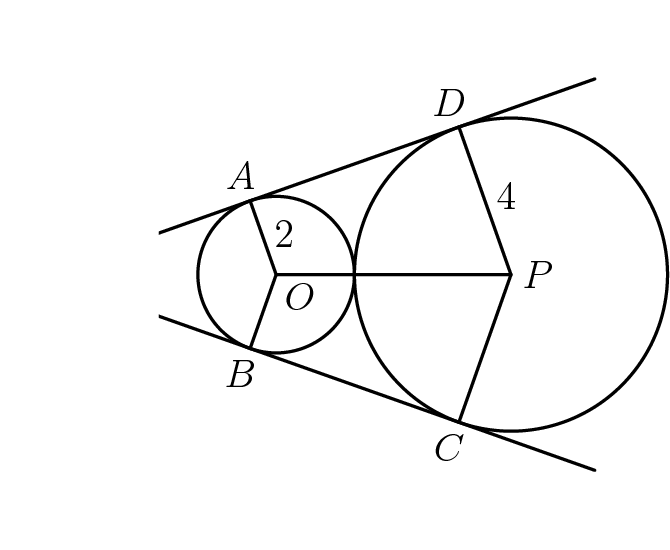
Circles with centers and have radii and , respectively, and are externally tangent. Points and on the circle with center and points and on the circle with center are such that and are common external tangents to the circles. What is the area of the concave hexagon ?
Show solution without answering
Key insight
Radii meet a tangent line at right angles, so OADP is a trapezoid with parallel sides 2 and 4. The Pythagorean theorem gives its height.
Solution
1. Use the mirror line. The line through both centers splits the figure into two matching halves. So the hexagon is two copies of the four-sided shape . Find that area and double it.
2. Right angles. A radius drawn to the point where a tangent line touches the circle meets that line at a right angle. So and both meet at right angles. That makes and parallel, and is a trapezoid with parallel sides and . Its height is the length .
3. Find . From , draw a line parallel to until it hits at a point . Then is a rectangle, so and .
4. That leaves . The circles touch each other from outside, so the distance between centers is . Triangle has a right angle at , so
So .
5. Trapezoid area. Average of the parallel sides times the height:
6. Hexagon. Two copies: .
The answer is .
Why this works
Two facts do all the work. A radius meets a tangent line at a right angle, which turns the picture into right-angled trapezoids. And the length of a tangent line touching two circles comes from a right triangle whose longest side joins the centers and whose short side is the difference of the radii. The mirror line through the centers means only half the figure needs to be computed.
Alternative approach
Extend to the left until it meets both tangent lines at a point . Triangle and triangle have the same shape, and is twice , so every length in the big one is twice the small one. Since and , we get and . Then and . The kite is two right triangles of area , so ; the kite is two of area , so . The hexagon is the big kite minus the small one: .
Concise solution
A shorter write-up, the way contest solutions are usually written. It may take a different route from the solution above.
The line is an axis of symmetry of the whole figure, so the hexagon is two congruent copies of quadrilateral ; find that area and double it.
Because is tangent to both circles, and . Thus and is a right trapezoid with parallel sides and and height .
To get , drop a perpendicular from to , meeting it at . Then is a rectangle, so and , while since the circles are externally tangent. In right triangle ,
Trapezoid area: . The hexagon has area .
The answer is .
Review in the AoPS books
- Introduction to Geometry, Chapter 11: Circles
- Introduction to Geometry, Chapter 8: Quadrilaterals
- Introduction to Geometry, Chapter 19: Problem Solving Strategies in Geometry (§19.1)
- Introduction to Geometry, Chapter 4: Perimeter and Area (§4.2, §4.3)
Similar problems
Problem © Mathematical Association of America (MAA), American Mathematics Competitions. Reproduced for non-commercial educational use. Solution and commentary are original to this site.