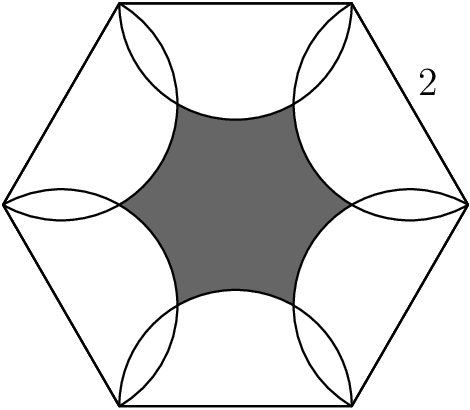
As shown in the figure below, six semicircles lie in the interior of a regular hexagon with side length 2 so that the diameters of the semicircles coincide with the sides of the hexagon. What is the area of the shaded region — inside the hexagon but outside all of the semicircles?
- A)
- B)
- C)
- D)
- E)
Answer
D
Key insight
Adjacent semicircles overlap, so do not subtract 3 pi; instead the shaded region is a central hexagon of side 1 minus six 60-degree circular segments.
Solution
Let be the center. Each semicircle has radius and is centered at the midpoint of a side, with (the apothem).
Where do two adjacent semicircles meet? Their centers and the shared vertex satisfy and (triangle is equilateral). The second intersection point is the mirror image of across line . Since is at distance from that line and , the reflection puts at distance from .
So the six meeting points lie on a circle of radius around , spaced apart: they form a regular hexagon of side , and the shaded region is that inner hexagon with six circular arcs bulging inward.
Consider one side of the inner hexagon and the semicircle center on its far side. , so the arc subtends at , and the bite it takes out of the inner hexagon is a circular segment of area
Shaded area inner hexagon six segments:
The answer is .
Why this works
Before subtracting shapes from a region, check whether they overlap; here neighboring semicircles share a lens near each vertex, so "hexagon minus six semicircles" is wrong. Describing the shaded region directly by its boundary (arcs between intersection points) leads to an honest decomposition: a polygon minus circular segments, each being sector minus triangle.
Alternative approach
Inclusion-exclusion: hexagon minus six semicircles plus the six lenses. Two unit circles with centers apart form a lens of area , and each lens lies entirely inside both semicircles. Total: .
The trap
Computing hexagon area minus six semicircles, 6 sqrt(3) - 3 pi, which double-subtracts the overlaps near each vertex.
Common mistakes
- Computing hexagon area minus six semicircles, 6 sqrt(3) - 3 pi, which double-subtracts the overlaps near each vertex.
- Assuming the semicircles reach the center or are tangent to each other; the apothem and the center distance show neither is true.
Techniques
Add construction lines/points (drop altitudes, extend segments, connect centers) · Cut the figure into known shapes (triangles, rectangles, sectors) · Exploit symmetry to reduce work or pair up objects