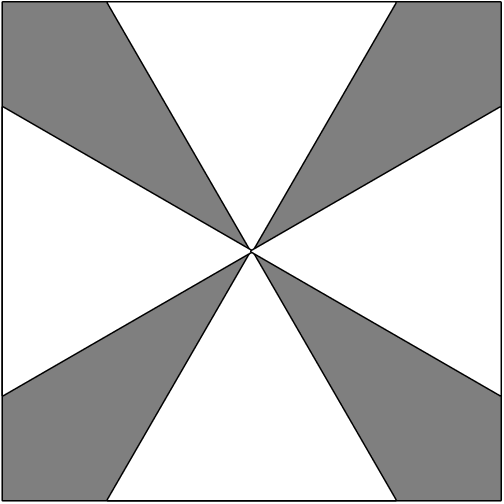
The figure below shows a square and four equilateral triangles, with each triangle having a side lying on a side of the square, such that each triangle has side length and the third vertices of the triangles meet at the center of the square. The region inside the square but outside the triangles is shaded. What is the area of the shaded region?
- A)
- B)
- C)
- D)
- E)
Answer
B
Key insight
The triangles' apexes meet at the center, so each triangle's height sqrt(3) is half the square's side; the square has area 12 and the triangles 4 sqrt(3).
Solution
An equilateral triangle of side has height . Each triangle stands on a side of the square with its apex at the center, so the distance from the center to each side of the square is . The square therefore has side and area
Each triangle has area , so the four triangles cover . The shaded region is the square minus the triangles:
The answer is .
Why this works
The only unknown is the size of the square, and the figure encodes it: the apex-to-base distance of a triangle is exactly half the square's side. After that, the shaded area is a straightforward subtraction. Look for how the pieces of a figure determine one another's dimensions before computing any areas.
The trap
Taking the square's side to be 2 (the triangle side) instead of twice the triangle's height, 2 sqrt(3).
Common mistakes
- Taking the square's side to be 2 (the triangle side) instead of twice the triangle's height, 2 sqrt(3).
- Using the triangle's height as the full side of the square, giving area and a negative shaded area.
Techniques
Cut the figure into known shapes (triangles, rectangles, sectors)