2006 AMC 10B Problem 19
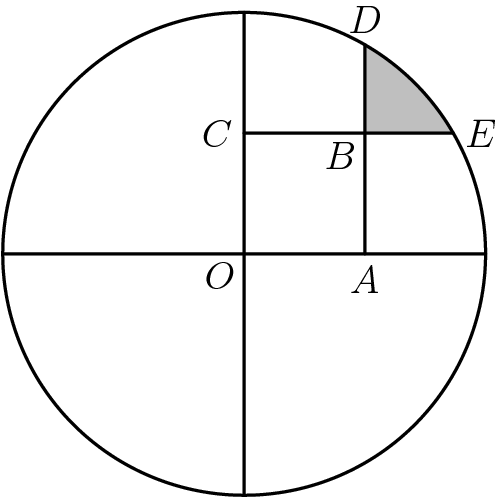
A circle of radius is centered at . Square has side length . Sides and are extended past to meet the circle at and , respectively. What is the area of the shaded region in the figure, which is bounded by , , and the minor arc connecting and ?
Show solution without answering
Key insight
Draw OD and OE to make a 30 degree slice of the circle. The slice is the shaded piece plus two thin triangles, OBD and OBE.
Solution
1. Put the square on a grid: , , , . The circle has radius .
2. Find . Side lies on the line . Going up that line until the distance from is : in right triangle , and , so . So . In the same way, .
3. Find the angle . Triangle has sides , , , so it is a -- triangle with the angle at : . By the same reasoning , so . Then
4. Draw and . They cut out a slice (sector) of the circle. The slice is made of three parts: the shaded region, triangle , and triangle .
5. Slice area. A slice is of the circle: .
6. Triangle . Its side runs along from height to height , so . The point is unit sideways from that line, so the height is . Area . Triangle is its mirror image, with the same area.
7. Shaded area = slice minus the two triangles:
The answer is .
Why this works
For a region with a curved edge, connect the circle's center to the ends of the arc. That makes a slice whose area is easy, and the rest of the slice is made of triangles. The lengths and give a -- triangle, which tells you both the slice angle and the length .
Alternative approach
Quick check with the choices. The shaded region is only part of the slice, so its area is less than . In (A), is negative, so (A) is less than . In (E), is positive, so (E) is too big. This rules out (E), which is what you get by adding the two thin triangles instead of taking them away.
Concise solution
A shorter write-up, the way contest solutions are usually written. It may take a different route from the solution above.
Place at the origin with , , . Then is on the line and on the circle, so ; similarly .
In right triangle , the legs are and with hypotenuse , so . By the same token , so and .
Draw and . The sector is made of the shaded region plus triangles and .
- Sector: .
- Triangle : base on the line , and is at distance from that line, so area . Triangle is its mirror image with the same area.
Shaded area .
The answer is .
Review in the AoPS books
- Introduction to Geometry, Chapter 11: Circles
- Introduction to Geometry, Chapter 4: Perimeter and Area (§4.2)
- Introduction to Geometry, Chapter 19: Problem Solving Strategies in Geometry (§19.1)
- Introduction to Geometry, Chapter 12: Circles and Angles
Similar problems
Problem © Mathematical Association of America (MAA), American Mathematics Competitions. Reproduced for non-commercial educational use. Solution and commentary are original to this site.