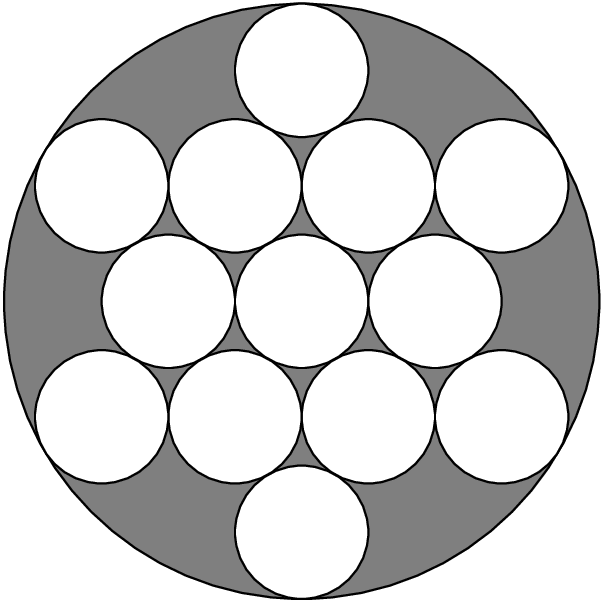
The figure below shows circles of radius within a larger circle. All the intersections occur at points of tangency. What is the area of the region, shaded in the figure, inside the larger circle but outside all the circles of radius
- A)
- B)
- C)
- D)
- E)
Answer
A
Key insight
Connect centers: two tangent steps of length 2 bending 120 degrees put the top center 2 sqrt 3 from the middle, so R = 2 sqrt 3 + 1.
Solution
The shaded area is where is the radius of the large circle, so we only need .
Let be the common center of the large circle and the middle small circle. Tangent unit circles have centers apart. In the picture the circles are arranged in a hexagonal packing: six circles surround the middle one at distance from , and the topmost circle touches two of those (the ones at the upper left and upper right).
Take the top circle's center and the two neighbors' centers and . Then , and sits at above the horizontal, while is straight above . Triangle has with , so it splits into two -- triangles and
The top circle is tangent to the big circle, so .
Shaded area:
The answer is .
Why this works
Tangent-circle figures are solved by connecting centers: tangency converts to fixed distances (sum of radii), and the centers form triangles with known sides. In a hexagonal packing the centers lie on equilateral triangles, so -- ratios give every distance. The final subtraction small circles from one big one is bookkeeping once is known.
Alternative approach
Coordinates: put at the origin. Neighbors of the center circle are at , and the top circle, tangent to both, has center with , so . Hence and the area is .
The trap
Assuming the big radius is 5 (from the vertical column of five circles as if they were stacked), giving 25 pi - 13 pi = 12 pi.
Common mistakes
- Assuming the big radius is 5 (from the vertical column of five circles as if they were stacked), giving 25 pi - 13 pi = 12 pi.
- Taking (the distance to the top center) and forgetting to add the top circle's radius, which gives .
Techniques
Add construction lines/points (drop altitudes, extend segments, connect centers) · Cut the figure into known shapes (triangles, rectangles, sectors)